
How to Invest in Pre-IPO Companies


Erik James Roberts — Founder & CIO, Infinitus Wealth Management. Purple Heart recipient, Wharton MBA.
Updated October 1, 2026
How to invest in pre-IPO companies comes down to three steps. First, confirm you qualify as an accredited investor. Second, choose an access path: a secondary marketplace, a pooled pre-IPO fund, or a single-company vehicle offered through your advisor’s custodian. Third, size the position for a multi-year hold that ends in an IPO, an acquisition, or another liquidity event. Get those three right and you can own a stake in a late-stage private company before it ever trades on an exchange.
That opportunity used to belong almost entirely to venture funds and company insiders. Today it is open to a much wider group of investors, and the ways to participate have improved dramatically. This guide walks through each step the way I walk through it with clients: what you are buying, who can buy it, where to buy it, what it costs, and what happens when the company finally lists.
What Does It Mean to Invest in a Pre-IPO Company?
A pre-IPO investment is ownership in a company whose shares do not yet trade on a public exchange. Most opportunities available to individual investors involve late-stage companies. These are businesses with real revenue, established products, and several funding rounds behind them, and they are widely expected to pursue a public listing or a sale in the coming years.
You can own that stake in two broad ways. You can hold the shares directly, or, far more commonly, you can own an interest in a vehicle that holds the shares for you. Either way, your return depends on what the company is worth at its eventual liquidity event compared with the price you paid going in.
Why Are More Investors Learning How to Invest in Pre-IPO Companies?
More of a great company’s growth now happens before it goes public. In earlier decades, companies often listed within a few years of founding, and public shareholders captured much of the expansion that followed. Today the best-funded companies can raise enormous rounds privately and choose their own timing.
According to IPO data compiled by University of Florida professor Jay Ritter, the median company going public in 2024 was 14 years old, and the 2025 median was 12 years. The long-run median for IPOs from 1980 through 2025 is 9 years. Those extra years are years of growth that public investors never had the chance to own.

The market for buying and selling private company shares has grown right alongside that trend. PitchBook estimates that U.S. venture secondary transactions reached about $106 billion in 2025, with direct purchases of company shares making up about $92 billion of that total. The same research shows how focused demand is: on one leading private-share marketplace, the 20 most-traded companies accounted for 86.4% of trading value in the fourth quarter of 2025. Investors are concentrating on a relatively small group of category leaders, which makes research and selectivity the real edge.

Who Can Invest in Pre-IPO Companies?
Most pre-IPO offerings are private placements under Regulation D, which means they are available to accredited investors. As an individual, you generally qualify if you meet any one of these tests:
Income: more than $200,000 in each of the past two years ($300,000 jointly with a spouse or spousal equivalent), with a reasonable expectation of the same this year.
Net worth: more than $1 million, alone or jointly, not counting the value of your primary residence.
Professional credentials: an active Series 7, Series 65, or Series 82 license in good standing.
Fund insiders: being a “knowledgeable employee” of the private fund making the investment.
Some vehicles require a higher standard called qualified purchaser status, which generally means owning at least $5 million in investments. The offering documents state which standard applies.
The rules may widen. The INVEST Act, which passed the House of Representatives in December 2025, would add an exam-based path to accredited status and index the dollar thresholds to inflation. As of this writing it awaits action in the Senate, so today’s tests still govern.
How to Invest in Pre-IPO Companies: The Three Main Paths
Once you qualify, the real decision is how you get in. Each path gives a different answer to the same three questions: what do you actually own, where is it held, and how many layers of fees sit between you and the company?
1. Online secondary marketplaces. These platforms match buyers with existing shareholders, usually early employees and early investors who want liquidity. You open a separate account with the platform, complete its accreditation process, and bid on available shares or interests. Selection can be broad. Your position lives outside your main investment account, though, company approval rights can delay or cancel trades, and each platform carries its own fee schedule.
2. Pooled pre-IPO funds. These funds hold a basket of private companies chosen by the fund manager. They offer diversification and, in some structures, lower minimums. In exchange, you own the fund rather than the companies, you pay the manager’s ongoing fees on top of any underlying costs, and your exposure is set by someone else’s picks. Many of these vehicles also limit how often and how much investors can redeem.
3. A single-company vehicle through your advisor’s custodian. Here you choose a specific company and subscribe to a vehicle that holds only that company’s shares, with the position recorded in the same brokerage account that holds the rest of your portfolio. Your advisor helps you evaluate the opportunity and size it alongside everything else you own. For investors who want to know exactly what they own, this path offers the clearest line of sight: one company, one account, one statement.

What Is a Single-Company SPV?
A single-company SPV, or special purpose vehicle, is a legal entity (usually an LLC or limited partnership) formed to hold shares of one private company on behalf of many investors. The sponsor acquires the shares, often in a single block from existing holders, and investors buy units of the vehicle. When the company goes public or is acquired, the vehicle passes the proceeds through to its investors as shares, cash, or both.
SPVs exist because private companies limit how many shareholders they can have and closely control who appears on their ownership records. Pooling many investors into one entity solves that problem and opens doors that would otherwise stay closed to individuals.
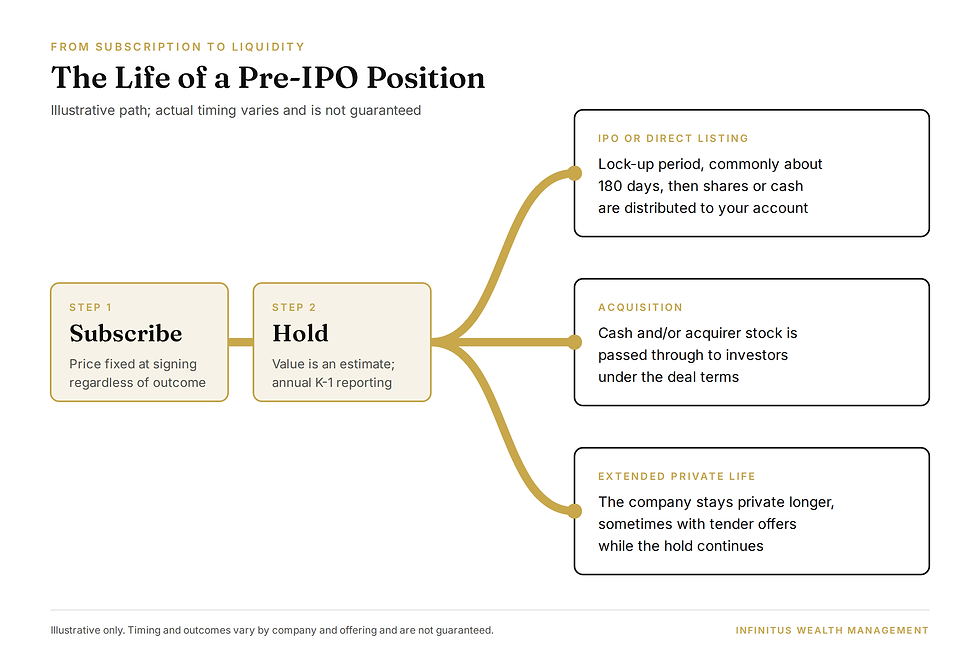
Two details matter most. Your subscription price is fixed when you sign, so your cost basis is locked in regardless of where the company is eventually valued. And the vehicle’s offering documents spell out every fee, the sponsor’s rights, and how and when proceeds are distributed. Reading those documents carefully is the single most important habit in learning how to invest in pre-IPO companies well.
How Much Do You Need to Invest in a Pre-IPO Company?
Minimums are set by each offering and appear in its subscription documents, so they vary from vehicle to vehicle. The more useful question is how much of your portfolio belongs in pre-IPO positions at all, and sizing is the part of how to invest in pre-IPO companies that investors most often rush.
Pre-IPO investments work best as a growth complement to a well-built core portfolio, not a replacement for it. A sound sizing framework rests on three questions:
Time: can this money stay invested for five years or longer without you needing it?
Concentration: how much of your wealth is already tied to private companies, a single employer’s stock, or one industry?
Resilience: would your long-term plan stay on track if this position took far longer than expected to reach a liquidity event, or if it were lost entirely?
When the answers line up, a pre-IPO allocation can add a distinctive source of growth that public markets alone may not provide. The right size comes out of a full look at your portfolio, income, and goals, which is exactly the work a fiduciary advisor should do with you.
What Happens to Your Pre-IPO Shares When the Company Goes Public?
Every pre-IPO investment is built around a liquidity event, and there are three common paths.
An IPO or direct listing. The company’s shares begin trading on an exchange. Pre-IPO shareholders, including SPVs, are typically subject to a lock-up period, commonly around 180 days, during which they cannot sell. After the lock-up, the vehicle either distributes public shares to investors or sells and distributes cash, depending on its terms. Distributed shares can then be managed like any other holding in your account.
An acquisition. If another company buys the business, the vehicle receives cash, acquirer stock, or a mix, and passes it through to investors according to the deal terms.
A longer private life. Some companies stay private for years beyond expectations, sometimes offering tender programs where existing holders can sell. Patience is part of the strategy, which is why sizing matters so much.
While the company is private, any value shown for your position is an estimate based on funding rounds, vehicle terms, and secondary market activity. It is not a market price.
What Does Pre-IPO Investing Cost?
Fees are where the answer to how to invest in pre-IPO companies differs most from one path to the next, so they deserve a careful read. Common layers include:
Placement or structuring fees charged by the vehicle sponsor at subscription.
Annual administrative or management fees for operating the vehicle.
Carried interest, a share of profits the sponsor keeps if the investment gains value.
Platform fees on marketplace transactions, or manager fees on pooled funds.
A single-company vehicle typically carries fewer layers than a fund-of-companies structure, since no second manager is selecting a portfolio on top of it. Whatever path you choose, ask for every fee in writing and understand how each one affects your net result.
At Infinitus, we receive no commission, placement fee, or markup on any pre-IPO offering. Pre-IPO positions held in a client account we manage fall under the same advisory fee described in our Form ADV, which starts at 1.00% annually and steps down to 0.80% as assets grow. One fee, disclosed up front, with no product compensation.
How Are Pre-IPO Investments Taxed?
Most SPVs are structured as partnerships, so investors usually receive a Schedule K-1 each year rather than a 1099. K-1s can arrive later in tax season, so plan your filing timeline with that in mind. When the investment is eventually sold or distributed, gains on positions held longer than one year generally qualify for long-term capital gains treatment.
The qualified small business stock (QSBS) exclusion, which can eliminate federal tax on certain gains, generally requires buying shares at original issuance from the company. Shares acquired on the secondary market typically do not qualify. Tax outcomes depend on your full situation, so coordinate with your CPA before you subscribe. If you don’t already have a CPA or attorney experienced with private investments, we can introduce you to one.
What Questions Should You Ask Before Investing?
Before committing capital to any pre-IPO opportunity, make sure you can answer these:
What exactly do I own: the shares, a unit of a vehicle, or a fund interest?
Who is the sponsor, and how did they acquire the shares?
What are all the fees, including carried interest?
Where will the position be held and reported?
What happens at an IPO, an acquisition, or a long delay?
How does this position fit with everything else in my portfolio?
How Infinitus Approaches Pre-IPO Investing
I built Infinitus around a simple belief: clients deserve to know exactly what they own. Our portfolios are built from directly owned securities rather than layered fund products, and our answer to how to invest in pre-IPO companies follows the same principle. We center on single-company access rather than pooled funds.
Through Altruist, the custodian that holds our clients’ accounts, accredited clients can take positions in select late-stage private companies through single-company vehicles, held inside their existing account alongside the rest of their portfolio. Our Private Companies strategy has long drawn on curated deal flow from my Wall Street network and Wharton connections, and this capability extends that work to companies that have not yet listed.
My path here started far from Wall Street. I enlisted immediately after high school, served as an infantryman with the 101st Airborne, and discovered investing through the Wall Street Warfighters Foundation while recovering from wounds I received in combat. Years working as a wealth advisor and a Wharton MBA followed. The discipline I learned in uniform still shapes how I evaluate every opportunity: do the reconnaissance, understand the terrain, and size every commitment so the mission succeeds even when conditions change.
Specific opportunities are shared with clients once an advisory relationship is in place. Account eligibility for pre-IPO positions is expanding, so ask us about current account types. You can learn more on our Pre-IPO Investing page.
Frequently Asked Questions
Can non-accredited investors invest in pre-IPO companies?
Most direct pre-IPO opportunities, including single-company SPVs, are limited to accredited investors under Regulation D. Some registered funds with private company exposure are open to non-accredited investors, though they carry their own fee and liquidity trade-offs. Pending legislation could add an exam-based path to accredited status in the future.
How long do you hold a pre-IPO investment?
Plan for a multi-year hold. The timeline depends on when the company completes an IPO or acquisition, plus any lock-up period afterward, commonly around 180 days. Some companies stay private much longer than expected, so pre-IPO capital should be money you will not need for at least five years.
Can I hold pre-IPO shares in my brokerage account?
In some cases, yes. Certain custodians now allow single-company pre-IPO vehicles to be held in the same brokerage account as your public investments, so everything appears on one statement. Infinitus clients can do this through Altruist, subject to account eligibility.
How are pre-IPO investments valued before an IPO?
Values are estimates based on recent funding rounds, the vehicle’s terms, and secondary market activity. They are not market prices and can change significantly. Your actual result is determined by the price you paid and the proceeds at the eventual liquidity event.
What fees come with pre-IPO investing?
Common fees include sponsor placement or structuring fees, annual administrative fees, and carried interest on gains, plus platform or fund-manager fees depending on the path. Infinitus receives no commission on pre-IPO offerings, and positions in managed accounts fall under our standard advisory fee.
Do pre-IPO shares qualify for QSBS?
Usually not when purchased on the secondary market, because QSBS generally requires acquiring shares at original issuance from the company. Your CPA can confirm treatment for any specific investment.
Add Private Companies to a Portfolio Built Around You If you are an accredited investor interested in owning select late-stage private companies inside a custom portfolio, start with an introductory conversation. We will look at your full picture, explain how single-company access works inside your account, and help you decide how it fits.

Pre-IPO Equity Planning: How Do You Position Before Your Company Goes Public?
Managing Portfolio Risk When Your Income and Stock Are Tied to One Company
Executive Compensation: Stock Options, Restricted Stock, and Deferred Compensation Plans
Wirehouse vs Independent RIA Fees: What’s the Real Difference?
Independent Fiduciary Advisor vs. Wirehouse Advisor: Which Is Right for You?
Important Disclosures Infinitus Wealth Management is a registered investment adviser. Registration does not imply a certain level of skill or training. This article is for general informational and educational purposes only and is not an offer to sell or a solicitation of an offer to buy any security. No specific offering is described or recommended. Pre-IPO investments are offered only to accredited investors, and in some cases only to qualified purchasers, solely through the applicable offering documents, which describe the vehicle, its fees and expenses, and its risks in full and should be read carefully before investing. Pre-IPO investments are speculative and illiquid, may result in the loss of the entire amount invested, and carry no guarantee that any company will complete an initial public offering, be acquired, or provide liquidity on any timeline. Values shown for private positions before a liquidity event are estimates derived from vehicle terms, funding rounds, and secondary market activity; they are not market prices or independently verified valuations. Availability of pre-IPO opportunities varies, and there may not be a live offering at any given time. Pre-IPO special purpose vehicles are made available through Altruist Financial LLC, member FINRA/SIPC, and are sourced and sponsored by Monark Capital Management LLC, an exempt reporting adviser. Neither Altruist nor Monark is affiliated with Infinitus Wealth Management. Infinitus receives no commission or other compensation from Altruist or Monark in connection with any pre-IPO offering; positions held in an account billed by Infinitus are included in the advisory fee described in our Form ADV. Third-party data cited (Jay R. Ritter, University of Florida; PitchBook) is believed reliable but has not been independently verified. Charts are for illustrative purposes only. Infinitus does not provide tax or legal advice; consult your CPA and attorney. Not FDIC insured. SIPC protection covers custody of assets and does not cover investment losses. All investments involve risk, including the potential loss of principal. Past performance is not indicative of future results. Advisory services are offered only pursuant to a written advisory agreement.


