Managing Portfolio Risk When Your Income and Stock Are Tied to One Company

Updated: Jun 11

How Executives, Corporate Professionals, and Equity-Compensated Employees Can Reduce Concentration Risk Without Abandoning Long-Term Growth
For many corporate professionals and executives, wealth accumulation does not happen through salary alone. It often comes through restricted stock units, stock options, employee stock purchase plans, bonuses, deferred compensation, and company retirement plans.
Over time, those benefits can create meaningful wealth. They can also create a hidden vulnerability: your paycheck, bonus potential, career trajectory, retirement savings, and investment portfolio may all depend on the same company.

That risk is easy to underestimate when the company is performing well. A rising stock price can make concentration feel like intelligence, loyalty, and patience being rewarded. Promotions, equity grants, and stock appreciation can all move in the same direction. The problem is that the same forces can work in reverse. If the company’s stock declines, it may coincide with layoffs, smaller bonuses, reduced future equity grants, or diminished career mobility.
This is the central challenge of managing portfolio risk when your income and stock are tied to one company. It is not simply an investment issue. It is a balance sheet issue. It is a tax issue. It is a liquidity issue. It is a career-risk issue. And for high-income professionals, it requires more than generic diversification advice.
At Infinitus Wealth Management, we view this type of situation through an integrated investment-management lens: how much company exposure you already have, how much future exposure is coming, how taxable sales should be structured, how much liquidity you need, and how to build a broader portfolio that supports long-term growth without allowing one stock to dominate your financial life.
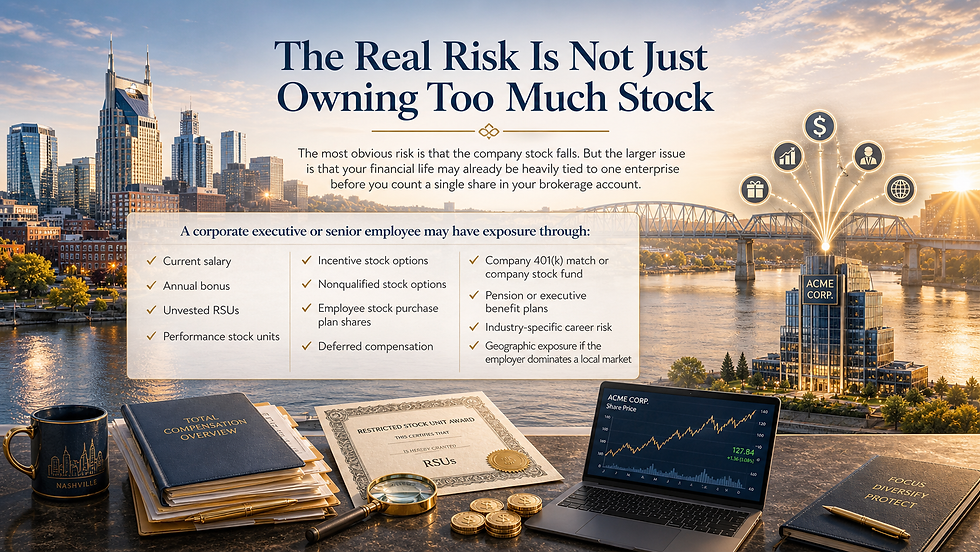
The Real Risk Is Not Just Owning Too Much Stock
The most obvious risk is that the company stock falls. But the larger issue is that your financial life may already be heavily tied to one enterprise before you count a single share in your brokerage account.
A corporate executive or senior employee may have exposure through:
Current salary
Annual bonus
Unvested RSUs
Performance stock units
Incentive stock options
Nonqualified stock options
Employee stock purchase plan shares
Deferred compensation
Company 401(k) match or company stock fund
Pension or executive benefit plans
Industry-specific career risk
Geographic exposure if the employer dominates a local market
The danger is not merely that the stock goes down. The danger is that several financial risks arrive together. A stock decline may reduce portfolio value. A business slowdown may reduce bonuses. A restructuring may reduce job security. A weak industry environment may limit opportunities at competitors. Future equity grants may be worth less. And if much of your net worth is illiquid, restricted, or tax-sensitive, you may not have the flexibility to respond.
That is why concentration risk should be measured across the full household balance sheet—not just the investment account.
A useful first step is to separate exposure into three categories:
Current company stock exposureThis includes vested shares, ESPP shares, company stock inside retirement accounts, and exercised option shares.
Future company stock exposureThis includes unvested RSUs, unvested options, performance stock units, expected future grants, and deferred compensation tied to company performance.
Human-capital exposureThis is your employment income, bonus potential, career path, and future earning power tied to the company or industry.
Many investors only track the first category. That is incomplete. If you own $500,000 of company stock, have $700,000 of unvested equity, and earn $400,000 per year from the same employer, your real company exposure is much larger than the visible stock position.

Why Concentration Can Feel Rational
Concentration often builds gradually. It rarely begins as a reckless decision.
An employee receives RSUs. The shares vest. Selling feels unnecessary because the company is strong. The stock appreciates. More grants vest. Selling now creates taxes. The employee knows the business well and believes in the leadership team. Meanwhile, the stock becomes a larger percentage of net worth.
This is how concentration usually develops—not through one dramatic choice, but through many small non-decisions.
There are several reasons high-performing employees hold too much employer stock:
They know the company well.Familiarity creates confidence. But knowing a company’s products, culture, or leadership does not eliminate market risk, valuation risk, competition risk, regulatory risk, or investor sentiment risk.
Taxes discourage selling. Large unrealized gains create hesitation. But refusing to sell solely because of taxes can allow a tax problem to become a risk-management problem.
The stock has worked. A successful investment often feels hardest to reduce. But the fact that a stock has created wealth does not mean it should continue to dominate the portfolio.
They expect more upside. This may be reasonable. The goal is not necessarily to sell everything. The goal is to decide how much exposure is appropriate relative to the household’s broader financial position.
They underestimate employment risk. Many employees think of their salary and portfolio as separate. In reality, if both depend on one company, the risks are connected.
Diversification does not mean pessimism about the company. It means recognizing that even excellent companies can experience major drawdowns, valuation compression, leadership transitions, product cycles, litigation, regulatory pressure, or industry disruption.
FINRA notes that diversification can reduce the risk of major losses caused by overemphasis on a single security or asset class. That principle becomes especially important when the single security is also your employer.
A Practical Framework: How Much Company Stock Is Too Much?
There is no universal number that applies to every investor. A founder, public-company executive, mid-career employee, and retiree with legacy company shares may each require a different plan. Still, practical guardrails help.
A common institutional-style approach is to categorize company-stock exposure by percentage of investable net worth:
Company Stock as % of Investable Assets | Risk Level | Planning Implication |
0%–5% | Low | Usually manageable if liquidity and taxes are appropriate |
5%–10% | Moderate | Monitor closely; rebalance around vesting and price moves |
10%–20% | Elevated | Create a formal reduction or risk-management plan |
20%–35% | High | Prioritize staged diversification and tax planning |
35%+ | Very high | Treat as a major balance-sheet risk, not just an investment preference |
For employees whose income is also tied to the company, the acceptable stock percentage should generally be lower than it would be for an outside investor. A retired investor with 10% in a former employer’s stock faces one kind of risk. A current executive with 10% in company stock, 25% of net worth in unvested equity, and most household income from the same company faces a different risk.
A useful rule: if a 40% decline in the company stock would meaningfully alter your retirement timeline, home purchase plan, college funding plan, or ability to leave the company, the position is too large to manage casually.
Another test: ask what percentage of your liquid portfolio you would allocate to the stock today if you received the same amount in cash. If the answer is far lower than your current position, inertia—not conviction—may be driving the allocation.

Start With a Full Portfolio Risk Exposure Inventory
Before deciding what to sell, hold, hedge, or reinvest, build a clear inventory. This should include both current and future exposure.
1. Vested Shares
List all vested company shares by account:
Taxable brokerage account
Company equity plan account
Employee stock purchase plan account
Retirement plan account
Trust account
Joint account
Any legacy shares held elsewhere
For each lot, track:
Number of shares
Cost basis
Unrealized gain or loss
Holding period
Whether shares are short-term or long-term
Any blackout restrictions
Whether shares are subject to insider trading policy restrictions
This matters because not all shares should be treated equally. A low-basis long-term share lot may be handled differently than recently vested RSUs with little appreciation.
2. Restricted Stock Units
RSUs are commonly misunderstood. When RSUs vest, they are generally taxed as compensation based on the value of the shares at vesting. The employer usually withholds taxes, but the withholding rate may not fully cover the employee’s actual tax liability, especially for high earners.
From an investment standpoint, vested RSUs are economically similar to receiving a cash bonus and immediately choosing to buy company stock. Once the shares vest, the employee has a decision: continue holding company stock or diversify.
That framing is important. If you would not use a cash bonus to buy more company stock, automatically holding vested RSUs may not make sense.
3. Stock Options
Stock options require more detailed planning because the tax consequences depend on the option type.
The IRS distinguishes between statutory stock options, such as incentive stock options, and nonstatutory options. Statutory options generally are not included in gross income when granted or exercised, though incentive stock options can create alternative minimum tax exposure; taxable income or deductible loss generally occurs when the acquired stock is sold.
For nonqualified stock options, exercise typically creates ordinary income equal to the spread between the fair market value and the strike price. That income is generally subject to payroll and income tax withholding.
For planning purposes, track:
Option type: ISO or NSO
Grant date
Vesting schedule
Expiration date
Strike price
Current market price
Bargain element
Alternative minimum tax exposure for ISOs
Post-termination exercise window
Insider trading restrictions
Whether exercise creates immediate liquidity or tax pressure
Options can expire worthless. They can also create significant tax bills if exercised without a sale plan. Managing them requires more precision than simply “holding for upside.”
4. Employee Stock Purchase Plan Shares
ESPPs can be valuable, especially when they include a purchase discount or look back feature. But they also add to employer-stock exposure. The discount may be attractive; the concentration risk may not be.
A practical approach is to use the ESPP benefit while selling shares on a disciplined schedule, subject to tax and holding-period considerations. For many employees, ESPP participation is best treated as compensation capture—not as a reason to accumulate an even larger employer-stock position.
5. Company Stock Inside a 401(k)
Some employees hold company stock inside a retirement plan, either by choice or through employer contributions. This exposure can be overlooked because it sits outside the brokerage account.
If employer stock exists inside a 401(k), it should be included in the total company-stock percentage. It may also require specific tax planning if net unrealized appreciation treatment is potentially relevant, though that is highly fact-specific and should be coordinated with a tax professional.
The “Vesting Day” Rule: Treat Every Vest as a New Investment Decision
One of the simplest ways to prevent concentration risk from growing is to create a rule for future vesting.
Each time RSUs vest, ask:
If I received this amount in cash today, how much would I invest in my employer’s stock?
For many employees, the answer is not 100%. Yet by doing nothing, they effectively choose 100%.
A structured vesting-day plan might look like this:
Sell 75%–100% of vested RSUs immediately upon vesting.
Reserve cash for estimated taxes if withholding is insufficient.
Reinvest proceeds into a diversified portfolio.
Retain only the amount that fits the target company-stock allocation.
Review total exposure quarterly or after major price moves.
This approach turns equity compensation into wealth-building capital rather than allowing it to accumulate into a single-stock bet.
For executives or insiders subject to blackout windows, this may require a 10b5-1 trading plan. Such plans can allow pre-scheduled sales under defined rules, though they must be designed carefully and in compliance with company policies and securities law requirements.

Create a Target Company-Stock Allocation
A serious concentration plan should begin with a target. Without a target, every sale feels arbitrary.
For example:
Current company stock: 28% of investable assets
Target company stock: 8%
Desired reduction: 20 percentage points
Time horizon: 12–24 months
Tax budget: manage gains across multiple tax years
Liquidity goal: build 12 months of expenses outside company exposure
Future vesting rule: sell 80% of new RSUs at vesting
The target should reflect:
Career stage
Job security
Total compensation structure
Retirement timeline
Existing liquidity
Tax bracket
Capital gains exposure
Family obligations
Risk tolerance
Future equity grants
Company volatility
Insider restrictions
A younger employee at a rapidly growing company may tolerate more exposure if they have a long time horizon and low spending needs. A senior executive within five years of retirement may need a much lower exposure threshold because the downside could directly affect retirement timing.
The key is to define the exposure intentionally rather than letting vesting schedules and stock appreciation define it by accident.

Tax-Aware Selling: Reduce Risk Without Creating Unnecessary Tax Drag
Taxes matter. But taxes should not be the only factor. A concentrated stock position with large embedded gains creates a tradeoff: selling may trigger taxes, but not selling may expose the portfolio to larger losses.
The right question is not “How do I avoid taxes?” The better question is:
How do I reduce uncompensated concentration risk in the most tax-efficient way available?
Prioritize High-Basis Shares First
If you have multiple lots, start by identifying shares with the lowest tax cost to sell. Recent RSU shares may have a cost basis close to the vesting price. If the stock has not moved much since vesting, selling those shares may create little capital gain.
This is often the easiest source of diversification.
Harvest Losses Elsewhere
If the portfolio has unrealized losses in other securities, those losses may help offset gains from selling company stock. Tax-loss harvesting can create room to diversify without the same tax drag.
However, wash-sale rules must be monitored carefully if similar securities are repurchased too quickly. For company stock, the issue may also arise if automatic purchases, ESPP purchases, dividend reinvestment, or option exercises occur near the time of a sale.
Spread Gains Across Tax Years
For large embedded gains, staged selling can help avoid realizing too much gain in a single tax year. This may be useful if the investor is near a tax bracket threshold, expects lower income in a future year, or wants to manage exposure to the net investment income tax.
The IRS states that the 3.8% net investment income tax applies to individuals, estates, and trusts with net investment income above applicable threshold amounts. IRS guidance also notes that individuals may be subject to NIIT based on the lesser of net investment income or the amount by which modified adjusted gross income exceeds the statutory threshold for their filing status.
Coordinate Charitable Giving
For investors who are charitably inclined, donating appreciated shares may be more tax-efficient than donating cash. A donor-advised fund can be useful when an investor wants to make a charitable contribution in one year but distribute grants to charities over time.
This can be especially powerful with low-basis company stock because the investor may avoid realizing capital gains while potentially receiving a charitable deduction, subject to tax rules and limitations.
Use Qualified Opportunity or Exchange Strategies Carefully
Some investors explore advanced tax-deferral tools after large stock sales. These can include opportunity-zone funds, exchange funds, or other specialized structures. These strategies may have restrictions, costs, liquidity limitations, and suitability concerns.
They should not be used merely to avoid taxes. They should be evaluated based on risk, fees, liquidity, diversification quality, time horizon, and whether the investor would want the underlying investment even without the tax benefit.
Avoid Letting Taxes Override Risk Management
A common mistake is refusing to sell because of a tax bill while ignoring the possibility of a larger pre-tax loss. Paying taxes on a gain is not failure. It is often the cost of turning concentrated wealth into durable wealth.
Managing RSUs: A Practical Playbook
RSUs are one of the most common sources of concentration risk.
A practical RSU plan should answer four questions:
How much of each vest should be sold?
How much cash should be reserved for taxes?
How should the proceeds be reinvested?
How will future vesting affect the overall allocation?
Example: RSU Concentration Plan
Assume an executive has:
$1.5 million taxable portfolio
$450,000 employer stock
$300,000 unvested RSUs vesting over three years
$350,000 salary and bonus
$120,000 annual living expenses
Target employer-stock exposure: 8% of investable assets
Current employer-stock exposure is 30% of the taxable portfolio, excluding unvested equity. Including future RSUs, the exposure is even higher.
A reasonable plan might include:
Sell 50% of current vested shares over the next 12 months.
Sell 80%–100% of future RSUs at vesting.
Keep a maximum 8% allocation to company stock.
Use proceeds to build a diversified equity and fixed-income allocation.
Reserve additional cash for tax payments.
Reassess after each vesting event and after major price changes.
The result is not an emotional decision to abandon the company. It is a controlled plan to prevent one employer from dominating the household balance sheet.
Managing Stock Options: Exercise Strategy Matters
Stock options can create significant wealth, but they can also create planning traps.
Nonqualified Stock Options
With NSOs, exercising typically creates ordinary income on the spread between the strike price and market value. If the option is deep in the money, the tax bill can be substantial.
A common approach is a same-day exercise and sale. This creates liquidity to pay taxes and reduces concentration. Another approach is a partial exercise and hold, but that increases company exposure and requires liquidity for taxes.
Questions to evaluate:
How much ordinary income will exercise create?
Will withholding cover the full tax liability?
Should exercise be spread across tax years?
Does the option expire soon?
Is the stock already a large share of net worth?
Would a same-day sale reduce risk more effectively?
Are there blackout windows or insider restrictions?
Incentive Stock Options
ISOs can be more tax-sensitive. Exercising and holding may create alternative minimum tax exposure, even without selling shares. A qualifying disposition may receive favorable tax treatment, but the required holding period creates market risk.
ISO planning should include:
AMT projection before exercise
Exercise size limits
Calendar-year timing
Liquidity planning for taxes
Sale strategy if the stock declines after exercise
Concentration limits
Coordination with tax advisor
The IRS notes that incentive stock options may create alternative minimum tax exposure in the year of exercise. That makes ISO planning especially important for high-income employees who may already have complex tax situations.
Avoid the Expiration Trap
Employees often wait too long to exercise options because they want to preserve optionality. That may be rational in some cases. But as expiration approaches, the planning window narrows.
A disciplined option review should begin at least 18–24 months before expiration. Waiting until the final months can force rushed decisions, larger tax bills, or avoidable concentration.

Build a Diversified Portfolio Around the Concentrated Position
Diversification should not be random. If the concentrated stock remains a meaningful holding, the rest of the portfolio should be designed around it.
For example, if the employer is a large technology company, the investor may already have substantial exposure to:
U.S. large-cap growth
Technology sector risk
Equity market beta
Valuation sensitivity
Interest-rate sensitivity
Momentum-driven investor sentiment
In that case, the rest of the portfolio may need to avoid simply duplicating the same exposures. Buying a broad market index fund may help, but if that index is heavily weighted toward the same sector or megacap growth style, the investor may still have significant overlap.
A more intentional portfolio may include:
U.S. equities with reduced employer-sector overlap
Dividend growth companies
International equities
Small- and mid-cap equities
High-quality fixed income
Municipal bonds for taxable investors
Treasury exposure
Short-duration bonds for liquidity
Alternative or private-market exposure where suitable
Cash reserves for flexibility
The goal is not to dilute returns for the sake of appearing diversified. The goal is to build a portfolio where more than one source of return can contribute to long-term compounding.
Liquidity Comes First
Before optimizing the portfolio, ensure liquidity is adequate.
Employees with concentrated stock sometimes appear wealthy on paper but lack flexible cash. This can become dangerous if the company stock declines at the same time employment risk rises.
A practical liquidity framework:
Emergency reserve:Six to twelve months of living expenses, held outside company stock.
Tax reserve:Cash for estimated taxes related to RSU vesting, option exercise, bonus income, or stock sales.
Near-term goals:Cash or high-quality short-duration fixed income for expenses due within one to three years, such as home purchase, tuition, relocation, or business transition.
Opportunity reserve:Capital available for future investment opportunities without needing to sell company stock during a downturn.
Liquidity is not a drag when properly sized. It is strategic flexibility.
Hedging Strategies: Useful, but Not a Substitute for Diversification
Some investors want to hedge rather than sell. Hedging can have a role, especially for executives with restrictions, low-basis shares, or large positions. But hedging is complex, costly, and not always available.
Potential strategies include:
Protective Puts
A protective put gives the investor downside protection below a certain price. The downside is cost. Put options can be expensive, especially for volatile stocks or longer time horizons.
Collars
A collar combines buying downside protection with selling upside potential. The investor may buy a put and sell a call. This can reduce out-of-pocket cost but limits gains above the call strike.
Prepaid Variable Forwards
A prepaid variable forward can allow monetization and partial risk reduction while deferring some tax consequences. These are complex and generally used for very large concentrated positions.
Exchange Funds
Exchange funds may allow qualified investors to contribute concentrated stock into a pooled fund and receive diversified exposure over time. These often require long lockups and are generally limited to accredited or qualified investors.
10b5-1 Trading Plans
For insiders, a 10b5-1 plan can create a predetermined selling schedule. This is not a hedge, but it can reduce behavioral and compliance obstacles to diversification.
Hedging should be evaluated based on cost, tax consequences, liquidity, restrictions, counterparty risk, and whether it actually reduces the relevant risk. In many cases, staged selling and reinvestment may be cleaner than complex hedging.
Behavioral Mistakes That Keep Investors Over-Concentrated
Concentration risk is partly technical and partly behavioral.
Mistake 1: Anchoring to the High Price
Investors often refuse to sell after a decline because the stock used to be higher. But the prior high price may have no bearing on future risk. A stock that declined 30% can decline another 30%.
Mistake 2: Treating Company Knowledge as Investment Edge
Working at a company may provide operational familiarity, but it does not guarantee insight into valuation, investor expectations, macro conditions, or future stock performance. Public markets price expectations, not just company quality.
Mistake 3: Selling Only the Losers
Employees may sell diversified investments to raise cash while holding employer stock because they “believe in it.” This can make concentration worse.
Mistake 4: Waiting for the Perfect Tax Year
Tax planning is valuable, but perfect tax timing rarely exists. Delaying every sale for tax reasons can leave the portfolio exposed for years.
Mistake 5: Ignoring Future Grants
An employee may reduce company stock from 25% to 15%, then allow new RSUs to push the allocation back up. Without a future-vesting rule, concentration rebuilds automatically.
A Step-by-Step Action Plan
A strong company-stock risk plan should be written down. The plan does not need to be complicated, but it should be specific.
Step 1: Calculate Total Exposure
Include vested shares, unvested equity, options, ESPP shares, company stock in retirement plans, and employment income.
Step 2: Set a Target Allocation
Decide the maximum percentage of investable assets that should remain in company stock.
Step 3: Rank Shares by Tax Cost
Identify high-basis shares, low-basis shares, short-term lots, long-term lots, and lots suitable for charitable giving.
Step 4: Establish a Selling Schedule
Use a staged plan. For example:
Sell high-basis shares immediately.
Sell a fixed dollar amount quarterly.
Sell a percentage of each RSU vest.
Use price-based rules for additional sales.
Spread gains across tax years where appropriate.
Step 5: Reinvest Proceeds Intentionally
Build a portfolio that reduces overlap with the employer stock and supports the investor’s broader goals.
Step 6: Coordinate Taxes
Work with a CPA or tax advisor to evaluate capital gains, AMT, NIIT, estimated payments, charitable giving, and option exercises.
Step 7: Review Quarterly
Concentration risk changes as the stock price moves, grants vest, options approach expiration, and personal circumstances evolve.

How Infinitus Wealth Management Can Help
For corporate professionals, executives, and equity-compensated employees, managing company-stock exposure requires more than a simple asset allocation model. It requires judgment, structure, and ongoing monitoring.
Infinitus Wealth Management helps clients evaluate company-stock concentration as part of the broader investment portfolio. That includes current holdings, future equity grants, liquidity needs, tax-aware sale planning, and reinvestment strategy.
Our approach emphasizes:
Active & Personalized Portfolio Management Portfolios are built around the client’s actual balance sheet, not a generic model.
Tactical Asset Allocation Company-stock exposure is evaluated alongside broader market conditions, sector risk, valuation, and portfolio overlap.
Market Research & Insights Employer stock is considered within the context of business quality, risk, industry exposure, and investment alternatives.
Tax-Efficient Investing Sales, reinvestment, charitable strategies, tax-loss harvesting, and option decisions are reviewed with after-tax outcomes in mind.
Capital Preservation & Risk Management The objective is not simply to maximize upside. It is to preserve the wealth already created while maintaining disciplined participation in long-term growth.
For many successful professionals, employer equity has been one of the most powerful wealth-building tools in their financial life. The next step is making sure that wealth does not remain too dependent on a single company.
Build a Strategy for Long-Term Wealth

The High-Net-Worth Wealth Management Checklist for Families With $5M to $25M
Managing Portfolio Risk When Your Income and Stock Are Tied to One Company
Generating Income with Stock Options: Strategies and Insights
Navigating Tax Implications for High Net Worth Individuals: Strategies to Reduce Your Taxes
Important Disclosures
Infinitus Wealth Management is a registered investment advisory firm. This article is provided for educational and informational purposes only and does not constitute investment, tax, legal, or accounting advice. It is not an offer or solicitation to buy or sell any security or to enter into any advisory relationship. Any references to specific strategies, withdrawal rates, tax provisions, or historical figures are general in nature and may not be appropriate for any individual investor.
Past performance is not indicative of future results. All investing involves risk, including the possible loss of principal. Tax laws are complex, change frequently, and have unique application to individual circumstances; please consult a qualified tax professional regarding your specific situation. Social Security rules, Medicare rules, and retirement account regulations are subject to legislative and regulatory change.
The information in this article was believed to be accurate at the time of writing but is not guaranteed. Readers should consult with their own qualified advisors before making any financial decisions specific to their situation.