

Wealth Management for Business Owners & Founders in Nashville
You built enterprise value through years of concentrated risk and disciplined execution. The next phase is different work: converting that concentrated, business-driven wealth into a diversified, actively managed portfolio engineered for long-term growth, tax efficiency, and capital preservation.
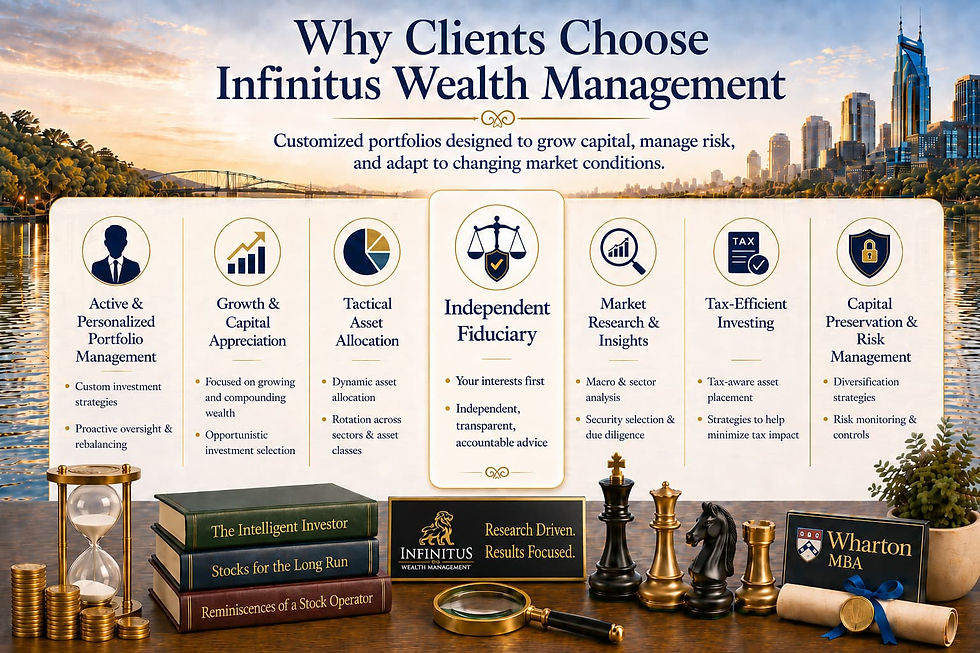
Portfolio management led by Erik James Roberts, MBA — Founder & Chief Investment Officer, Infinitus Wealth Management. Wharton MBA · U.S. Army veteran (101st Airborne) · Purple Heart recipient.

• Fiduciary • Custom Portfolios • Active Management • Investment Focused
⎯ The Transition
From Building a Business to
Managing the Capital It Created
For most founders, wealth is not accumulated gradually. It is created — through scaling a company, reinvesting profits, and ultimately a liquidity event — and it arrives concentrated, complex, and deeply tied to a single enterprise.
The challenge begins the moment that wealth has to be managed outside the business. The focus shifts from compounding enterprise value to preserving, structuring, and intelligently growing capital that no longer has the company's operating engine behind it.
This is precisely where wealth management for business owners diverges from generic advice. The work is not simply "investing the proceeds." It is restructuring a balance sheet for an entirely new phase of financial life — one that demands deliberate planning and active portfolio management rather than passive allocation into a model.
At Infinitus Wealth Management, we manage that transition directly. Portfolios are built from individual stocks and bonds, calibrated against the risk an owner already carries, and overseen by the person making the decisions — not handed off to a third-party fund.
⎯ The Founder's Balance Sheet
The Risks Entrepreneurs Carry
That Traditional Investors Don't
Owning and building a company creates a financial profile most advisory models were never designed for. Wealth management for business owners has to start by naming those risks honestly.
01
Concentration
A large share of net worth sits in one company or one industry — the same engine that built the wealth is also its single largest risk.
02
Liquidity
Income and cash flow arrive irregularly through distributions, earn-outs, and one-time events rather than a steady paycheck.
03
Complex Tax Exposure
Capital gains, ordinary income, and timing decisions interact in ways that can materially change after-tax outcomes.
04
Limited Diversification
During growth years, capital is reinvested into the business — leaving little outside it until an exit forces the question.
05
Transition Risk
The period around an exit or scale-up is where avoidable, emotionally driven mistakes tend to concentrate.
06
Correlated Assets
Real estate, private holdings, and public equity can quietly move together, magnifying exposure rather than offsetting it.
⎯ Managing Concentration

The Unwind Is Where Value Is Won or Lost
For most founders, a single holding represents years of work — and the majority of their net worth. The instinct is usually one of two extremes: hold it indefinitely, or sell it all at once. Both carry real cost. Concentration left unchecked can give back years of gains in a single bad quarter, while an abrupt exit can trigger an outsized tax bill and leave capital sitting in cash at the wrong moment. We work the path between them.
Because Infinitus builds portfolios from individual stocks and bonds in an account you own, a concentrated position can be reduced in measured steps — proceeds reinvested directly into a broader set of holdings, with timing kept in line with your wider tax picture. The objective isn't simply to end up diversified; it's to keep building while you get there. Each step is sized to your liquidity needs, your gain exposure, and the rest of your balance sheet, so the transition reinforces the portfolio's growth profile rather than interrupting it.
⎯ Our Approach
Active & Personalized Portfolio Management, Built Around Your Balance Sheet
No two founders have the same financial structure, so no two portfolios should be identical. We construct each one to complement — never duplicate — the risk profile of your business.
01
What we build with
Custom portfolios of individual stocks and bonds. We do not use mutual funds and rarely use ETFs, which keeps tax-lot management, concentration, and risk calibration in our hands rather than a fund company's.
02
What we account for
Proceeds from income or a liquidity event, ongoing ownership stakes and earn-outs, existing accounts, tax timing, lifestyle and reinvestment liquidity, and family and legacy objectives.
03
How we manage risk
High-quality, diversified equity exposure paired with strategic fixed income — and, where appropriate, options-based hedging to define downside without forcing a sale.
04
Who manages it
You work directly with the Founder & Chief Investment Officer inside a fiduciary framework. The person setting strategy is the person you talk to.
⎯ After the Exit
Liquidity Events & Capital Deployment
A sale or liquidity event introduces a new problem most founders haven't faced before: a large pool of cash and pressure to do something with it. That combination invites tax consequences, cash drag, and emotionally driven reinvestment.
Our approach emphasizes thoughtful pacing, portfolio construction aligned to long-term goals, and the discipline to avoid reactive misallocation. Capital shouldn't simply be redeployed — it should be repositioned with intention.

⎯ After-Tax Outcomes
Tax-Efficient Portfolio Management
for Business Owners
For business owners, tax considerations often become far more visible after a liquidity event. We design portfolios with after-tax results in mind from the start.
01
Capital-gains awareness
Timing and tax-lot management around realizations, particularly when unwinding a concentrated position.
02
Asset location
Positioning holdings across taxable and tax-advantaged accounts to support after-tax efficiency.
03
Tax-loss harvesting
Realizing losses where appropriate — far easier with individual securities than with packaged funds.
04
Municipal bonds
Tax-aware fixed income for taxable accounts where the after-tax math supports it.
05
Tennessee advantage
No state income tax on wages or investment income since the Hall tax was fully repealed in 2021.
06
Coordinated withdrawals
Reinvestment and distribution decisions coordinated rather than handled in isolation.

⎯ The Full Picture
Integrating Business and Personal Wealth
Effective wealth management for business owners requires seeing both sides of the balance sheet at once — enterprise value and personal portfolio assets — rather than treating them as separate problems.
-
Better risk calibration across your entire net worth
-
More efficient allocation of new capital
-
Clearer long-term and legacy planning
-
A portfolio that reflects your whole financial life, not isolated accounts
⎯ Built by a Veteran, for Veterans
Veteran Business Owners: A Firm That Shares Your Story
Infinitus is a veteran-built firm. Founder & Chief Investment Officer Erik James Roberts served in the U.S. Army's 101st Airborne Division and earned the Purple Heart before building his career in investment management — the same path from service to ownership that many veteran entrepreneurs have walked themselves.
For veterans who have built companies — including those holding SDVOSB or VOSB status — we've created a dedicated practice covering the full arc of ownership: growing wealth while you build, positioning for a sale, and managing the capital a successful exit creates.
☆
Veteran-Founded · Veteran-Owned
Before, During, and After the Exit
-
Portfolio management alongside the business during the growth years
-
Planning for how SDVOSB status factors into a future sale
-
Structured, tax-aware deployment of exit proceeds
-
Direct access to the founder managing your capital

⎯ Local Roots, National Reach
Nashville-Based, Serving Business Owners Broadly
Based on Music Row, we work with business owners across Nashville and throughout the country. The region's growth has created an environment where founders and entrepreneurs are generating significant wealth — often requiring more sophisticated, hands-on investment management than traditional model-portfolio advisory provides.
Whether you've just sold a company or you're years from an exit and want a plan for the capital outside it, the conversation starts the same way: directly, and on your terms.


Schedule a Consultation
Investment-Focused Wealth Management
Confidential discussion
No Obligation
Explore our Investment Strategies
⎯ Getting Started
From First Call to Fully Invested.
01
Discovery Call
A no-pressure conversation about your goals, holdings, and what you want your wealth to do — by phone, video, or in person.
02
Strategy Review
We review your holdings, goals, and risk profile, then share observations on how your portfolio is positioned and where a tailored approach may help.
03
Onboarding
A fully digital onboarding — accounts opened and transfers authorized with a few e-signatures, most holdings moving over exactly as they are.
04
Active Management
We build and manage your portfolio — with ongoing research, tax-aware adjustments, and regular portfolio reviews as markets and your life evolve.
Already working with an advisor? We initiate the transfer with your former firm for you — no awkward phone call on your end — and most accounts move in-kind, exactly as they are. See how switching works →
⎯ Transparent, Fee-Only
Fees
We accept zero commissions and act as a fiduciary — mandated by law and ethically bound to put our clients’ interests first. Our fee is based on assets under management, so we do well when you do well.

No Performance Fees
We charge no performance fees. Our simple and straightforward Assets Under Management fee allows our advisors to focus on achieving our clients' goals.

No Commissions
We charge no commissions on buying and selling investments, so our interests are completely aligned as we grow and protect your accounts.

No Financial Planning Costs
A complimentary and comprehensive financial plan is available to all clients of Infinitus Wealth Management.

⎯ Frequently Asked Questions
Wealth Management for Business Owners: Questions Founders Ask
What should business owners do with their money after selling a company? After a liquidity event, the priority shifts from building enterprise value to preserving and intelligently compounding capital. That usually means a structured, paced plan for deploying proceeds, coordinating capital-gains timing, and constructing a diversified portfolio aligned with long-term goals — rather than reinvesting quickly under pressure.
How do founders reduce concentration risk without disrupting their strategy? Diversification is usually a structured process executed over time, not a single transaction. It can involve gradual transitions, timing around tax consequences, balancing public and private exposure, and, where appropriate, options strategies such as protective puts or collars to manage downside while a position is unwound.
How are options used to manage a concentrated stock position? Protective puts can establish a defined floor under a position, covered calls can generate income against shares an owner intends to hold. These are risk-management tools applied within a fiduciary framework — not guarantees of any result. Options involve risk and aren't suitable for every investor.
Why invest in individual stocks and bonds instead of mutual funds or ETFs? Owning individual securities keeps tax-lot management, concentration, and risk calibration in our hands rather than a fund company's — which supports tax-loss harvesting and tailoring at the position level. Infinitus builds custom portfolios from individual stocks and bonds; we don't use mutual funds and rarely use ETFs.
Do business owners need a financial advisor or an investment manager? Many founders benefit most from a manager who actively constructs and oversees the portfolio, particularly during the transition from business-concentrated wealth to diversified capital. The distinction matters: a manager makes the investment decisions, while many advisors primarily gather assets into third-party models.
How does Tennessee's tax environment affect a business owner's portfolio? Tennessee has no state income tax on wages or investment income following the full repeal of the Hall income tax in 2021, which can be favorable for residents. Federal tax strategy, however, remains central — including capital-gains awareness, asset location, and municipal bond use in taxable accounts.
What does Infinitus Wealth Management charge? Infinitus is a fee-only fiduciary and charges asset-based advisory fees beginning at 1.00% on portfolios under $1 million and scaling down toward 0.80% at $10 million and above. There are no commissions and no performance fees.


Who We Serve
Investment Management for Individuals, Families, & Institutions


⎯ Explore Further
Related Strategies & Reading
Disclosure: Infinitus Wealth Management is a registered investment adviser. Registration does not imply a certain level of skill or training. All investments involve risk, including the potential loss of principal. No investment strategy can guarantee returns or eliminate risk, and past performance is not indicative of future results. Advisory services are offered only pursuant to a written advisory agreement.