

Tactical Asset Allocation
in Nashville
Actively Positioning Portfolios Through Market Cycles
A dynamic approach that adjusts portfolio exposures as market conditions evolve — guided by economic trends, valuations, and risk, never by short-term speculation.
Infinitus Wealth Management · Nashville · We Don't Just Manage Wealth. We Build It.
Our Approach
Positioning capital as conditions change
Tactical asset allocation is a dynamic investment approach designed to adjust portfolio exposures as market conditions evolve. At Infinitus Wealth Management in Nashville, we actively evaluate economic trends, interest rates, valuations, and risk factors to determine how capital should be positioned across asset classes, sectors, and investment styles. Rather than setting an allocation once and leaving it untouched, we treat positioning as an ongoing discipline — revisited as the data changes and as the balance between risk and opportunity shifts.
Markets move through cycles. Economic expansion, contraction, monetary policy shifts, and changing investor sentiment all influence how different assets perform, and those forces rarely move in unison. Tactical asset allocation allows us to respond thoughtfully to those changes — aiming to manage downside risk during periods of stress while positioning portfolios to participate when conditions and valuations support it. The objective is not to predict the market, but to keep capital aligned with where the evidence points.
The Framework
What is tactical asset allocation?
Disciplined, research-driven adjustments to allocations based on current data and forward-looking analysis. Unlike static models that stay fixed regardless of conditions, a tactical framework allows flexibility within a structured process — so the portfolio can lean toward or away from risk as the evidence warrants, without ever abandoning the underlying plan.

These decisions are always guided by analysis and long-term objectives, not short-term reaction. In practice, tactical adjustments may include:
✓ Increasing or reducing equity exposure
✓ Shifting allocations between growth and value styles
✓ Adjusting sector weightings
✓ Managing interest rate sensitivity within fixed income
✓ Rebalancing based on valuation and risk metrics
Data-Driven Evaluation
The signals behind every decision
Our tactical decisions are supported by in-depth research and ongoing market evaluation. We weigh multiple, independent signals before adjusting or maintaining portfolio risk — because no single indicator tells the whole story, and the most reliable read comes from where several lines of evidence agree. The result is a decision grounded in data rather than headlines or emotion.

Defense and Offense
Managing risk — and positioning for opportunity
One primary objective of tactical asset allocation is risk management. By adjusting exposure during periods of elevated risk or stretched valuations, portfolios may better navigate volatility and avoid carrying more risk than the environment justifies. But tactical allocation is not solely about defense — it also lets portfolios capitalize on emerging opportunities when valuations, trends, and data support increased exposure. As economic leadership rotates across sectors and asset classes, we evaluate where risk-adjusted opportunities appear most attractive and position capital where it has the potential to work most efficiently. Both modes draw on the same disciplined research; only the conclusion changes with the conditions.

How Tactical Decisions Are Made
A disciplined, repeatable process

Within Your Long-Term Plan
Integrated with long-term strategy
Tactical adjustments are implemented within a broader long-term framework, never in isolation. Strategic allocation reflects each client's objectives, time horizon, and risk tolerance; tactical positioning operates within those parameters to refine exposure as conditions change. This integrated approach lets a portfolio adapt to short- and intermediate-term market dynamics while remaining firmly aligned with the goals it was built to achieve — so day-to-day movement never pulls the plan off course.

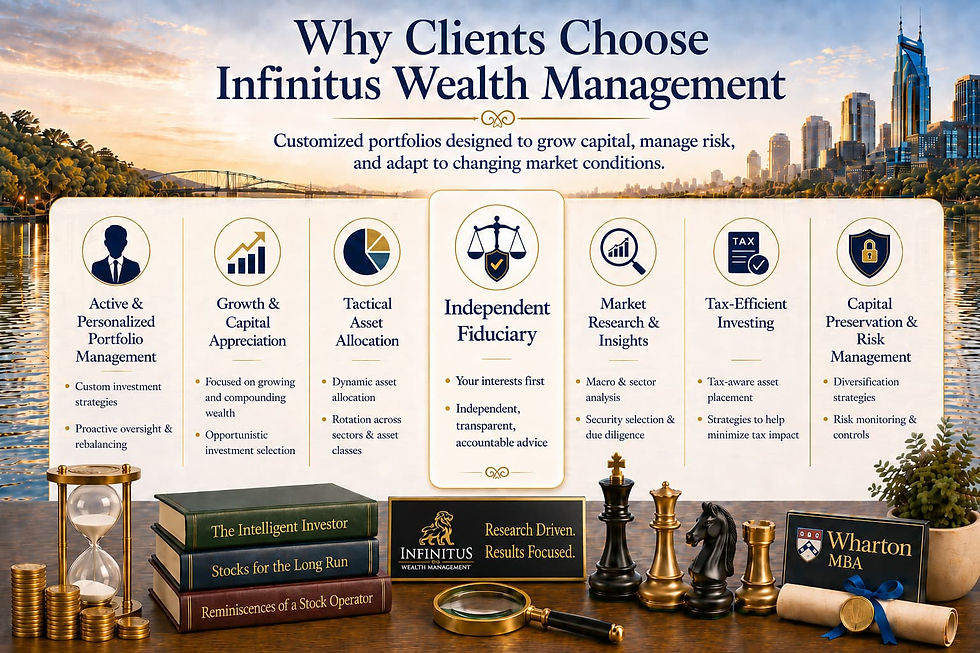
⎯ Local Roots, National Reach
Nashville-Based, Serving Investors Nationwide
Based on Music Row, we work with clients across Nashville and throughout the country. Our clients come to us with different backgrounds, goals, and stages of wealth — but often with the same need: more thoughtful, hands-on investment management than a traditional model-portfolio approach provides.
Whether you are building wealth, preparing for retirement, managing concentrated assets, or looking for a more personalized strategy for the capital you have already accumulated, the conversation starts the same way: directly, thoughtfully, and on your terms.


Schedule a Consultation
Investment-Focused Wealth Management
Confidential discussion
No Obligation
Explore our Investment Strategies
⎯ Getting Started
From First Call to Fully Invested.
01
Discovery Call
A no-pressure conversation about your goals, holdings, and what you want your wealth to do — by phone, video, or in person.
02
Strategy Review
We review your holdings, goals, and risk profile, then share observations on how your portfolio is positioned and where a tailored approach may help.
03
Onboarding
A fully digital onboarding — accounts opened and transfers authorized with a few e-signatures, most holdings moving over exactly as they are.
04
Active Management
We build and manage your portfolio — with ongoing research, tax-aware adjustments, and regular portfolio reviews as markets and your life evolve.
Already working with an advisor? We initiate the transfer with your former firm for you — no awkward phone call on your end — and most accounts move in-kind, exactly as they are. See how switching works →
Transparent, Fee-Only
Fees
We accept zero commissions and act as a fiduciary — mandated by law and ethically bound to put our clients’ interests first. Our fee is based on assets under management, so we do well when you do well.

No Performance Fees
We charge no performance fees. Our simple and straightforward Assets Under Management fee allows our advisors to focus on achieving our clients' goals.

No Commissions
We charge no commissions on buying and selling investments, so our interests are completely aligned as we grow and protect your accounts.

No Financial Planning Costs
A complimentary and comprehensive financial plan is available to all clients of Infinitus Wealth Management.


⎯ Frequently Asked Questions
Tactical asset allocation, explained
What is tactical asset allocation? Tactical asset allocation is a dynamic approach that makes disciplined, research-driven adjustments to a portfolio's allocations based on current market data and forward-looking analysis. Unlike static models that stay fixed regardless of conditions, a tactical framework allows flexibility within a structured process — guided by analysis and long-term objectives rather than short-term speculation. In practice, it means continuously asking whether the current environment justifies more risk, less risk, or the same risk, and acting only when the evidence supports a change.
How is tactical allocation different from strategic allocation? Strategic allocation sets the long-term baseline that reflects your objectives, time horizon, and risk tolerance — the structure your portfolio returns to over time. Tactical allocation operates within that baseline, refining exposure across asset classes, sectors, and styles as market conditions change. The two work together: strategy provides the structure and the discipline, tactics provide the flexibility to respond to what markets are actually doing. One sets the destination; the other adjusts the route.
What data drives tactical decisions? We analyze macroeconomic indicators such as inflation, GDP trends, and employment data; interest rates and central bank policy; equity and fixed income valuations; corporate earnings trends and credit conditions; and market breadth, momentum, and volatility. Together these signals inform whether portfolio risk should be adjusted or maintained.
Is this the same as market timing? No. Market timing attempts to predict short-term moves and jump in and out of the market, often driven by emotion and rarely repeatable. Tactical asset allocation makes measured, research-driven adjustments to exposure within a long-term framework — aiming to manage risk and capture opportunity, not to guess tops and bottoms. We are adjusting how capital is positioned, not abandoning the market and trying to time a re-entry.
Does tactical allocation reduce risk? No strategy can eliminate market risk, but thoughtful allocation decisions can help reduce concentration risk, improve diversification, moderate portfolio volatility, and align risk exposure with prevailing conditions. Risk management is central to our approach, particularly during periods of economic uncertainty or market stress.
How is Infinitus different from most wealth managers? We build portfolios from individual stocks and bonds you directly own—never mutual funds and rarely ETFs. Direct ownership gives you cost control, tax control, and full transparency into every position, and it lets us hedge specific holdings with options rather than running a one-size-fits-all fund model.
How often are tactical adjustments made? There is no fixed schedule. Adjustments are made when research and data support them — not on a calendar and not for the sake of activity. We continuously evaluate conditions and act when valuations, trends, and risk metrics warrant a change, always within each client's long-term strategy. In quiet markets that may mean few changes; in fast-moving ones, more. The trigger is always the evidence, not the clock.
⎯ Explore Further
Related Strategies & Reading
Disclosure: Infinitus Wealth Management is a registered investment adviser. Registration does not imply a certain level of skill or training. All investments involve risk, including the potential loss of principal. No investment strategy can guarantee returns or eliminate risk. Past performance is not indicative of future results. Advisory services are offered only pursuant to a written advisory agreement.