

Tax-Efficient Investing
in Nashville
Improving After-Tax Returns
Investment performance is ultimately measured after tax. We build tax awareness directly into portfolio construction — helping you keep more of what you earn while staying aligned with your long-term capital objectives.
Infinitus Wealth Management · Nashville · We Don't Just Manage Wealth. We Build It.
Our Approach
Tax efficiency, built into the process
At Infinitus Wealth Management in Nashville, tax-efficient investing is integrated directly into the investment management process rather than treated as a year-end afterthought. Investment performance is ultimately measured on an after-tax basis, and thoughtful tax planning within portfolio construction can meaningfully influence long-term wealth accumulation.
Our approach focuses on managing portfolio decisions with awareness of their tax impact — helping clients retain more of their investment returns while maintaining alignment with long-term capital objectives. The goal is not to let the tax tail wag the dog, but to ensure tax considerations complement sound investment decisions at every step.
Why It Matters
What is tax-efficient investing?
Tax-efficient investing means structuring portfolios and making decisions in a way that considers the tax implications of gains, income, and distributions. The objective is not simply to minimize taxes in the short term, but to improve long-term after-tax outcomes — because the return you keep is the only one that funds your goals.

In practice, a tax-efficient approach may include:
✓ Managing realized gains and losses strategically
✓ Evaluating holding periods for tax treatment
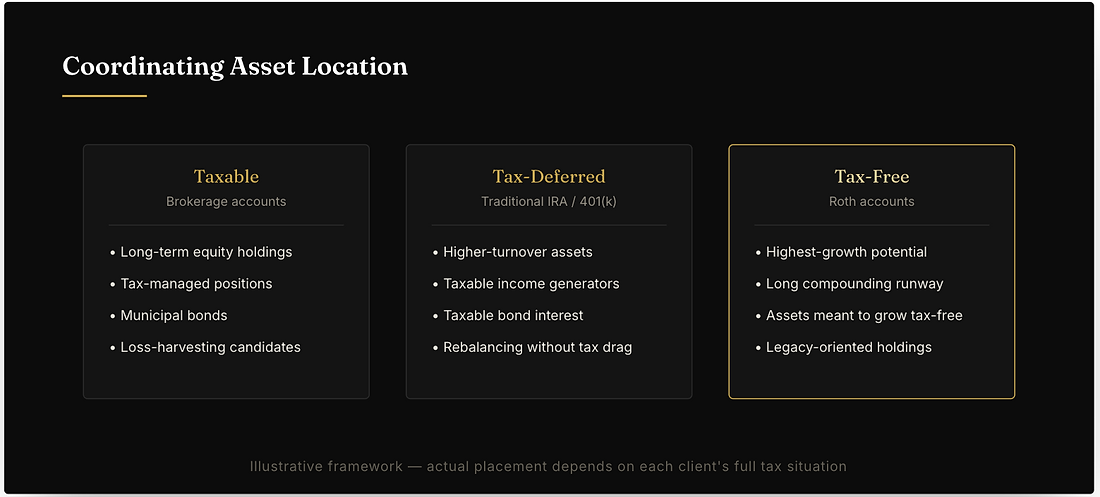
✓ Coordinating asset location across taxable and tax-advantaged accounts
✓ Monitoring portfolio turnover
✓ Managing distributions and income-generating investments
Asset Location
The right asset in the right account
Different investments may be more suitable for certain account structures. Placing income-producing or higher-turnover assets in tax-advantaged accounts, when appropriate, can enhance overall portfolio efficiency. Asset location is always coordinated with your overall asset allocation to support both growth and tax awareness.
Gain & Loss Management
Strategic gain and loss management
Investment portfolios naturally generate gains and losses over time. Our process incorporates thoughtful evaluation of when to realize gains and when to offset them with losses, where appropriate. Where it fits the broader strategy, tax-loss harvesting may be used to:
✓ Offset realized gains
✓ Reduce taxable income within applicable limits
✓ Improve portfolio tax efficiency without materially altering long-term allocation
These decisions are made within the broader investment strategy so that tax considerations complement — rather than override — your portfolio objectives. Owning individual securities, rather than pooled funds, is what gives us the position-level control to make these moves precisely.
Turnover & Distributions
Managing the sources of tax drag
Portfolio turnover and distribution management can meaningfully influence tax outcomes. Our active management process weighs these factors alongside investment merit to help manage unnecessary tax drag while preserving portfolio integrity.

The Long View
Long-term compounding and tax awareness
Taxes can meaningfully impact long-term compounding. By integrating tax considerations into portfolio construction and ongoing management, we seek to support more efficient capital accumulation while maintaining disciplined investment principles — every dollar not lost to unnecessary tax stays invested and continues to compound.

How Tax Awareness Is Applied
A disciplined, year-round process
Taxes can meaningfully impact long-term compounding. By integrating tax considerations into portfolio construction and ongoing management, we seek to support more efficient capital accumulation while maintaining disciplined investment principles — every dollar not lost to unnecessary tax stays invested and continues to compound.

⎯ Local Roots, National Reach
Nashville-Based, Serving Investors Nationwide
Based on Music Row, we work with clients across Nashville and throughout the country. Our clients come to us with different backgrounds, goals, and stages of wealth — but often with the same need: more thoughtful, hands-on investment management than a traditional model-portfolio approach provides.
Whether you are building wealth, preparing for retirement, managing concentrated assets, or looking for a more personalized strategy for the capital you have already accumulated, the conversation starts the same way: directly, thoughtfully, and on your terms.


Schedule a Consultation
Investment-Focused Wealth Management
Confidential discussion
No Obligation
Explore our Investment Strategies
⎯ Getting Started
From First Call to Fully Invested.
01
Discovery Call
A no-pressure conversation about your goals, holdings, and what you want your wealth to do — by phone, video, or in person.
02
Strategy Review
We review your holdings, goals, and risk profile, then share observations on how your portfolio is positioned and where a tailored approach may help.
03
Onboarding
A fully digital onboarding — accounts opened and transfers authorized with a few e-signatures, most holdings moving over exactly as they are.
04
Active Management
We build and manage your portfolio — with ongoing research, tax-aware adjustments, and regular portfolio reviews as markets and your life evolve.
Already working with an advisor? We initiate the transfer with your former firm for you — no awkward phone call on your end — and most accounts move in-kind, exactly as they are. See how switching works →
Transparent, Fee-Only
Fees
We accept zero commissions and act as a fiduciary — mandated by law and ethically bound to put our clients’ interests first. Our fee is based on assets under management, so we do well when you do well.

No Performance Fees
We charge no performance fees. Our simple and straightforward Assets Under Management fee allows our advisors to focus on achieving our clients' goals.

No Commissions
We charge no commissions on buying and selling investments, so our interests are completely aligned as we grow and protect your accounts.

No Financial Planning Costs
A complimentary and comprehensive financial plan is available to all clients of Infinitus Wealth Management.


⎯ Frequently Asked Questions
Tax-efficient investing, explained
What is tax-efficient investing? Tax-efficient investing means structuring portfolios and making investment decisions in a way that considers the tax implications of gains, income, and distributions. It can include managing realized gains and losses, evaluating holding periods, coordinating asset location across account types, monitoring turnover, and managing distributions. The objective is to improve long-term after-tax outcomes — not simply to minimize taxes in any single year.
What is asset location, and how is it different from asset allocation? Asset allocation decides what you own — the mix of stocks, bonds, and other holdings. Asset location decides where you hold each of those assets across taxable, tax-deferred, and tax-free accounts. Placing higher-turnover or income-producing assets in tax-advantaged accounts, when appropriate, can improve overall efficiency. We coordinate location with allocation so the two work together rather than at cross-purposes.
What is tax-loss harvesting? Tax-loss harvesting is the practice of realizing losses on certain positions to offset realized gains and, within applicable limits, reduce taxable income. Done thoughtfully, it can improve a portfolio's tax efficiency without materially altering its long-term allocation. We use it within the broader strategy, so tax moves complement your investment objectives rather than override them.
Does tax-efficient investing mean avoiding taxes entirely? No. The goal is not to eliminate taxes or let tax considerations drive every decision — that often undermines sound investing. The goal is to improve after-tax results by being deliberate about timing, location, turnover, and distributions, so taxes complement rather than dictate the strategy. Even modest improvements in after-tax return can compound meaningfully over time.
Why do individual stocks and bonds help with tax efficiency? Because we build portfolios from individual securities you directly own — not mutual funds, and rarely ETFs — we have position-level control over what is sold, when, and in which account. That control is what makes precise gain and loss management, asset location, and turnover discipline possible. Pooled funds can pass through taxable distributions you don't control; direct ownership puts those decisions in our hands.
How is Infinitus different from most wealth managers? We build portfolios from individual stocks and bonds you directly own—never mutual funds and rarely ETFs. Direct ownership gives you cost control, tax control, and full transparency into every position, and it lets us hedge specific holdings with options rather than running a one-size-fits-all fund model.
Does Infinitus provide tax advice? We manage portfolios with tax awareness and coordinate closely with your tax professionals, but we are an investment adviser, not a tax preparer or CPA. We do not provide tax or legal advice. For tax filing and formal tax planning, we work alongside your accountant so your investment strategy and tax strategy stay aligned.
⎯ Explore Further
Related Strategies & Reading
Disclosure: Infinitus Wealth Management is a registered investment adviser. Registration does not imply a certain level of skill or training. All investments involve risk, including the potential loss of principal. No investment strategy can guarantee returns or eliminate risk. Past performance is not indicative of future results. Advisory services are offered only pursuant to a written advisory agreement.