

High-Net-Worth Wealth Management in Nashville
Significant wealth brings a different set of problems: concentration, taxes that compound at the highest brackets, accounts scattered across institutions, and the weight of preserving what you've built for the next generation. We manage all of it as one integrated portfolio.
Portfolio management led by Erik James Roberts, MBA — Founder & Chief Investment Officer, Infinitus Wealth Management. Wharton MBA · U.S. Army veteran (101st Airborne) · Purple Heart recipient.

• Fiduciary • Custom Portfolios • Active Management • Investment Focused
⎯ The Challenge of Scale
At High Net Worth, the Problem Isn't Returns
— It's Complexity
By the time wealth reaches a meaningful scale, the question is rarely "how do I grow this?" It's "how do I preserve it, keep more of it after taxes, manage the risks I've accumulated, and pass it on intelligently?"
High-net-worth families rarely arrive with a clean, single portfolio. They arrive with concentration from a business or legacy stock, multiple accounts across institutions, real estate, private holdings, and a tax picture that grows more consequential with every dollar.
Effective high-net-worth wealth management begins by treating all of it as one integrated balance sheet — then managing it actively, with individual securities, around the goals that actually matter at this level: preservation, after-tax growth, and continuity across generations.
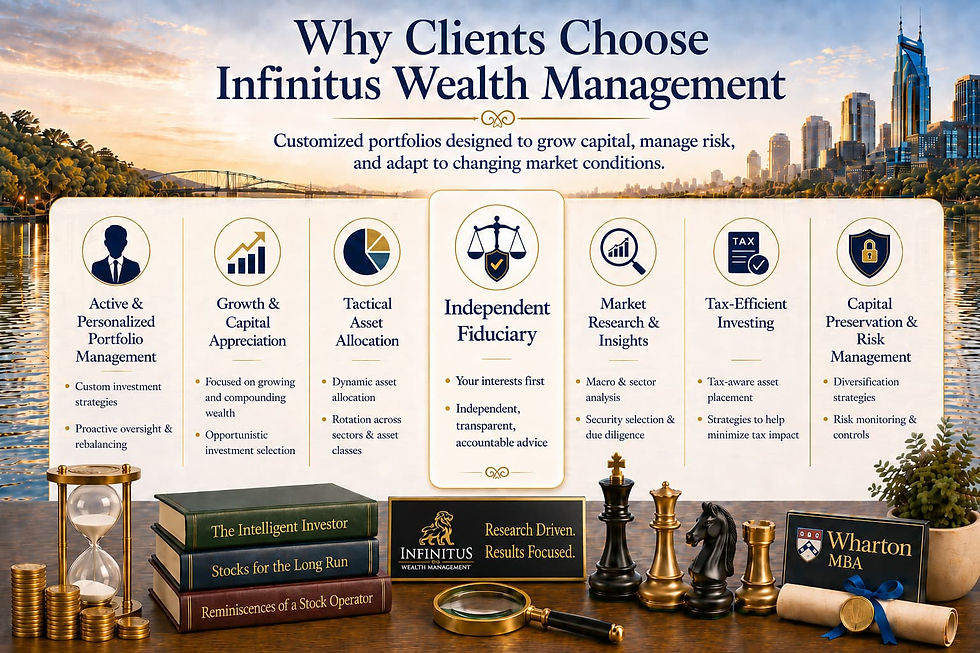
At Infinitus, that portfolio is built and overseen directly by the Chief Investment Officer, inside a fee-only fiduciary relationship — not handed to a model or a product.

⎯ What Changes at High Net Worth
Six Realities That Reshape How Wealth Should Be Managed
These are the forces that separate managing significant wealth from simply investing. They are the landscape we build every high-net-worth portfolio against.


⎯ Our Approach
Growth You Can Keep, Capital You Can Protect
At high net worth, the objective is rarely the highest possible return. It's the right return for the risk you're willing to carry — wealth that keeps growing without exposing what you've built to outsized drawdowns.
-
High-quality diversified equity for long-term growth
-
A deliberate fixed-income foundation for stability
-
Options-based hedging where appropriate to define downside
-
Calibrated to your family's goals, horizon, and risk tolerance
⎯ Keeping More of What You've Earned
After-Tax Wealth Is the Number That Matters
At the highest brackets, tax efficiency isn't a footnote — it's one of the largest levers on long-term wealth. We build it into the portfolio at the security level, not as an afterthought.
-
Asset location across taxable, tax-deferred, and tax-free accounts
-
Tax-loss harvesting — far more precise with individual securities
-
Municipal bonds in taxable accounts where the after-tax math supports it
-
Capital-gains awareness on every realization
-
Tennessee advantage — no state income tax since the 2021 Hall tax repeal


⎯ Capital Preservation
Managing the Risk You've Accumulated
Large portfolios often carry a large, hard-to-unwind position — founder stock, inherited shares, an oversized winner. Selling outright can trigger major taxes or sacrifice a holding you'd rather keep.
Where appropriate, we use disciplined options strategies — protective puts and collars — to define the downside on a core position while you hold it or diversify on your own timeline. The objective is control: staying invested while bounding how much risk you carry.
⎯ Built to Outlive You
Wealth Structured for the Next Generation
Wealth at this level is measured in generations, not years. The portfolio you've built is meant to support a spouse, children, grandchildren, and the causes you care about — long after you've stepped back from managing it yourself. That is an investment mandate in its own right. It should be built for continuity and durability across decades, with every decision made in service of the legacy it's meant to fund.
What separates wealth that transfers intact from wealth that quietly leaks away is usually decided at the handoff — and it's won with strategy, not luck. Because we own individual stocks and bonds rather than commingled funds, we manage every transition at the tax-lot level: weighing low-basis positions, using the step-up in cost basis, and timing gifts so more of what you've built reaches the people it's meant for. We keep liquidity ready for estate settlement and equalizing inheritances without forced sales, coordinate directly with your estate attorney and CPA, and — when families want it — bring the next generation into the conversation. In my experience, wealth lasts when heirs are well prepared for it, not simply when the documents are in order.

⎯ Local Roots, National Reach
Nashville-Based, Serving Families Nationwide
Based on Music Row, we work with high-net-worth individuals and families across Nashville and throughout the country. The region's growth in healthcare, technology, and entertainment has created substantial wealth — and a need for the kind of active, customized management that standardized advisory models can't provide.
Whether your wealth came from a business, a career, an inheritance, or a liquidity event, the conversation starts the same way: directly, and on your terms.


Schedule a Consultation
Investment-Focused Wealth Management
Confidential discussion
No Obligation
Explore our Investment Strategies
⎯ Getting Started
From First Call to Fully Invested.
01
Discovery Call
A no-pressure conversation about your goals, holdings, and what you want your wealth to do — by phone, video, or in person.
02
Strategy Review
We review your holdings, goals, and risk profile, then share observations on how your portfolio is positioned and where a tailored approach may help.
03
Onboarding
A fully digital onboarding — accounts opened and transfers authorized with a few e-signatures, most holdings moving over exactly as they are.
04
Active Management
We build and manage your portfolio — with ongoing research, tax-aware adjustments, and regular portfolio reviews as markets and your life evolve.
Already working with an advisor? We initiate the transfer with your former firm for you — no awkward phone call on your end — and most accounts move in-kind, exactly as they are. See how switching works →
⎯ Transparent, Fee-Only
Fees
We accept zero commissions and act as a fiduciary — mandated by law and ethically bound to put our clients’ interests first. Our fee is based on assets under management, so we do well when you do well.

No Performance Fees
We charge no performance fees. Our simple and straightforward Assets Under Management fee allows our advisors to focus on achieving our clients' goals.

No Commissions
We charge no commissions on buying and selling investments, so our interests are completely aligned as we grow and protect your accounts.

No Financial Planning Costs
A complimentary and comprehensive financial plan is available to all clients of Infinitus Wealth Management.

⎯ Frequently Asked Questions
High-Net-Worth Wealth Management — Questions Families Ask
What is considered high-net-worth, and does it require a different investment approach? High-net-worth typically refers to investable assets of roughly one million dollars or more, though the more important distinction is complexity rather than a threshold. As wealth grows, priorities shift from pure accumulation toward preservation, tax efficiency, concentration management, and coordination across accounts and generations — which calls for active, customized portfolio management rather than a standardized model.
How do you manage a large concentrated stock position? Concentrated positions are managed as a deliberate process rather than a single sale. Depending on circumstances, that can involve paced diversification timed around capital gains, balancing exposure across the broader portfolio, and using options strategies such as protective puts or collars to define downside while a position is held or unwound. These are risk-management tools applied within a fiduciary framework, not guarantees.
How do you reduce taxes on a high-net-worth portfolio? Tax efficiency is built into portfolio design through asset location across account types, tax-loss harvesting at the individual-security level, capital-gains awareness, and the use of municipal bonds in taxable accounts where the after-tax math supports it. Tennessee residents also benefit from no state income tax following the Hall tax repeal in 2021. Tax strategy is coordinated with your CPA and is not a substitute for tax advice.
Why use individual stocks and bonds instead of funds or a family office? Owning individual securities gives direct control over tax-lot management, concentration, income timing, and precise risk calibration — control that commingled funds give up. Infinitus builds custom portfolios from individual stocks and bonds rather than mutual funds, and rarely uses ETFs, providing the customization high-net-worth families need without the cost and complexity of a full family-office structure.
How do you balance growing wealth with preserving it? Preservation and growth are not opposing goals but a calibration. We pair high-quality diversified equity for long-term growth with a deliberate fixed-income foundation and, where appropriate, options-based hedging to manage downside. The balance is tailored to each family's objectives, time horizon, and tolerance for volatility rather than a one-size-fits-all allocation.
Can you coordinate with my CPA and estate attorney? Yes. Infinitus is an investment-first firm, and the portfolio is managed in coordination with your existing tax and estate professionals so that investment decisions, tax strategy, and your long-term wealth-transfer goals work together rather than in isolation.
What does Infinitus Wealth Management charge? Infinitus is a fee-only fiduciary and charges asset-based advisory fees beginning at 1.00% on portfolios under $1 million and scaling down toward 0.80% at $10 million and above. There are no commissions and no performance fees.


Who We Serve
Investment Management for Individuals, Families, & Institutions


⎯ Explore Further
Related Strategies & Reading
Disclosure: Infinitus Wealth Management is a registered investment adviser. Registration does not imply a certain level of skill or training. All investments involve risk, including the potential loss of principal. No investment strategy can guarantee returns or eliminate risk, and past performance is not indicative of future results. Advisory services are offered only pursuant to a written advisory agreement.