
Wirehouse vs Independent RIA Fees: What’s the Real Difference?

Updated: Aug 11

Erik James Roberts — Founder & Chief Investment OfficerWharton MBA
Wirehouse vs independent RIA fees come down to architecture. A wirehouse typically bundles advice, products, and platform into a layered cost structure, while an independent fee-only RIA charges a single published advisory fee — and when the portfolio is built from individual stocks and bonds, that one fee is generally the complete cost. The headline percentages can look similar; the all-in numbers usually don’t.
Both models serve investors every day, and each grew out of a genuine strength. Wirehouses offer scale, brand familiarity, and a full-service platform. Independent RIAs offer alignment, transparency, and portfolios shaped around the client rather than a product menu. The best news in this comparison is how much power sits with you: fee structures are fully knowable, the differences are measurable, and once you see them clearly, choosing becomes one of the most confident decisions in your financial life.
How Do Wirehouse Fees Work?
A wirehouse advisory account usually charges a program fee — commonly published in the range of about 1.0% to 1.5% of assets per year — that covers the advisor’s guidance and the firm’s platform. That fee is real value: research infrastructure, reporting systems, and an advisor’s time all cost money to deliver.
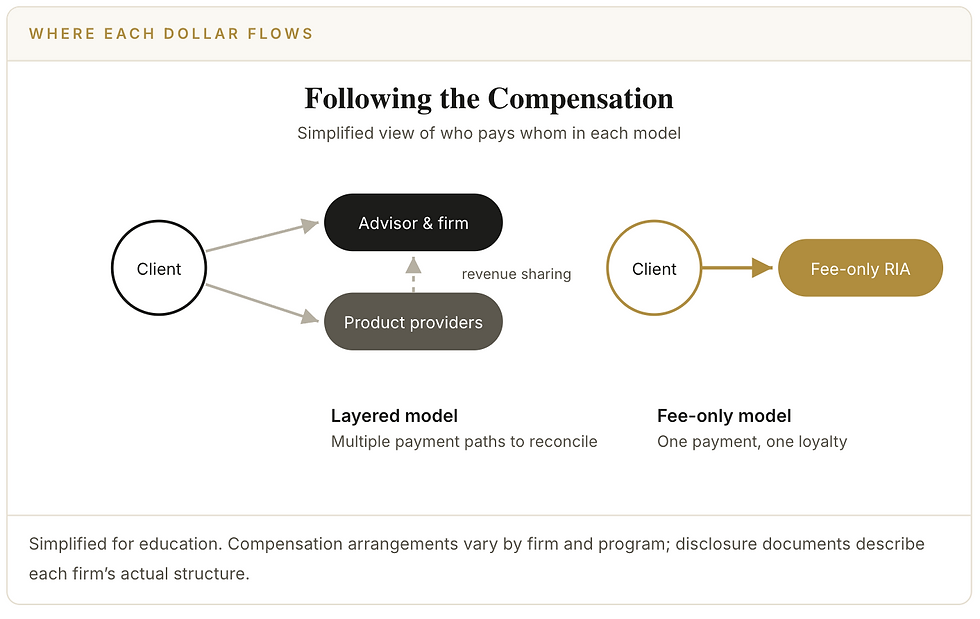
The layer worth knowing about sits underneath. When the portfolio inside that account holds mutual funds, separately managed products, or similar vehicles, each of those carries its own internal expense ratio — frequently somewhere between roughly 0.2% and 1.0% per year depending on the product mix. Those expenses are deducted inside the products themselves rather than appearing as a statement line item, and some programs also include platform or administrative charges. All of it is disclosed — simply across several documents — and investors who take a moment to add the layers together gain a genuinely useful piece of knowledge: their complete, all-in number.

How Do Independent RIA Fees Work?
A fee-only independent RIA charges one advisory fee — usually a percentage of assets under management — and accepts nothing else. No commissions, no revenue sharing, no product payments. The fee is published, it appears on the statement, and it is the same number the firm files with regulators. Industry-wide, fee-only advisory fees commonly fall between about 0.5% and 1.25% depending on portfolio size and service depth.
The structure matters as much as the level. Because a fee-only fiduciary is paid solely by the client, the recommendation and the compensation point in the same direction. And when the portfolio is constructed from individual stocks and individual bonds rather than packaged products, the second layer of the stack simply does not exist — there is no fund inside the account quietly charging its own expense ratio. At Infinitus Wealth Management, that is the model by design: custom portfolios of individual securities, a tiered advisory fee published at 1.00%, 0.95%, 0.90%, and 0.80% as assets grow, and no product compensation of any kind.
Wirehouse vs Independent RIA Fees: The Side-by-Side Numbers
Put the two structures next to each other and the comparison stops being about the advisory fee and starts being about the all-in cost. A wirehouse account charging 1.25% with a product lineup averaging 0.60% in expense ratios has an all-in cost near 1.85%. A fee-only RIA charging 1.00% on a portfolio of individual securities has an all-in cost of 1.00%. Both advisory fees look ordinary on their own; the 0.85-point spread between the totals is where the comparison actually lives.
The point is not that one model is virtuous and the other is not. It is that wirehouse vs independent RIA fees can only be compared honestly at the all-in level, and the all-in level requires reading past the first number you are shown. An investor who knows to ask for both layers is already most of the way to a good decision.
What Does the Difference Add Up To Over Time?
Percentages this small feel abstract until they meet a long horizon. On a hypothetical $2,000,000 portfolio, an all-in cost of 1.85% is $37,000 per year, while 1.00% is $20,000 — a $17,000 annual difference before any market movement. Carried across 20 years of retirement or accumulation, and allowing the savings themselves to stay invested, the gap compounds into a sum that can rival years of spending. The exact figure depends entirely on markets and behavior, which no one can promise; the direction of the arithmetic, though, never changes.

How Do You Evaluate Any Fee Structure?
Five questions surface the complete picture in one conversation, at any firm of either type:
What is the advisory fee, and is the full schedule published in writing?
What are the expense ratios of everything held inside the portfolio?
Do you or your firm receive commissions, revenue sharing, or any payment from product providers?
Are there platform, program, or administrative fees beyond the advisory fee?
What is my all-in cost as a single percentage, in writing?
A quality firm of either model answers all five without hesitation. Clear answers are themselves a signal: transparency about cost usually travels with transparency about everything else.

What Does a Single Fee Buy at Infinitus?
We built Infinitus Wealth Management around the answer we wanted to give that fifth question. Our advisory fee is published, tiered, and complete: 1.00%, stepping down to 0.95%, 0.90%, and 0.80% as a relationship grows. It is the only compensation we receive — no commissions, no revenue sharing, no product payments of any kind — and because every portfolio we manage is built from individual stocks and individual bonds, there is no second layer of expense ratios working underneath it. The number on your statement is the number.
What that one fee delivers is the part we’re proudest of. Every client portfolio is custom-built from our twelve proprietary investment strategies — researched, selected, and actively overseen security by security, never assembled from a model menu. You own each position directly, in your own name, at an independent custodian, which means complete transparency into exactly what you hold and why. Direct ownership also unlocks precision that packaged products can’t offer: individual tax lots to manage, dividends selected on purpose, bonds with real maturity dates, and the ability to tailor around concentrated stock, charitable goals, or a business sale. As a fee-only independent fiduciary, we owe you our best judgment on every recommendation — and because our fee is our only incentive, our best judgment is all we have to sell.
Clients tell us the feeling this structure creates is the real product: the quiet confidence of knowing precisely what you pay, precisely what you own, and precisely whose side your advisor is on. That clarity is what a single fee buys.
Which Structure Fits You?
Investors who value a household brand name and an all-under-one-roof banking relationship often feel at home at a wirehouse, and that comfort has genuine worth. Investors who want a single published fee, a fiduciary standard applied to every recommendation, and a portfolio of individual securities built for their specific situation tend to find the independent model a natural fit — and increasingly, that is the direction sophisticated investors are choosing. The encouraging truth is that this decision can be made with complete information: wirehouse vs independent RIA fees are knowable to the decimal point for anyone willing to ask five questions.
If you’d like to see what those five answers look like at Infinitus — including a clear, written picture of your current all-in cost next to ours — we welcome the conversation. Reviewing a fee structure costs nothing, takes one meeting, and leaves you more confident about your money no matter which direction you choose. Clarity about cost is the foundation of confidence in everything an advisory relationship delivers, and clarity is where we start.
Frequently Asked Questions
Are independent RIA fees always lower than wirehouse fees?
Not always at the headline level — advisory fee ranges overlap. The difference usually appears in the all-in cost, because portfolios built from individual securities avoid the underlying fund expense ratios that often sit beneath a wirehouse advisory fee.
What is a typical all-in fee at a wirehouse?
Published advisory fees commonly range from about 1.0% to 1.5% of assets, and when portfolios hold mutual funds or similar products, underlying expense ratios can add roughly 0.2% to 1.0% on top — bringing the all-in cost meaningfully higher than the advisory fee alone.
How do fee-only RIAs charge?
A fee-only RIA charges a single advisory fee — typically a percentage of assets under management — and accepts no commissions or product payments. When the portfolio is built from individual stocks and bonds, that one fee is generally the complete cost of management.
What questions reveal the true cost of an advisory relationship?
Five questions do most of the work: What is the advisory fee? What are the expense ratios inside the portfolio? Does the advisor receive commissions or revenue sharing? Are there platform or program fees? And is the full fee schedule published in writing?


Important Disclosures. Infinitus Wealth Management is a fee-only, independent registered investment adviser. This article is provided for educational and informational purposes only and does not constitute investment, legal, or tax advice, nor an offer or solicitation to buy or sell any security. Fee ranges cited for the industry reflect commonly published figures and are illustrative; the fees of any specific firm or program may differ and are described in that firm’s disclosure documents. All charts are hypothetical illustrations, do not represent any actual account, and assume simplified conditions for educational clarity. Investing involves risk, including the possible loss of principal. Past performance does not guarantee future results. Before making decisions about an advisory relationship, review each firm’s Form ADV and fee schedule and consult your own tax and legal professionals regarding your individual circumstances. Advisory services are offered only to clients or prospective clients where Infinitus Wealth Management and its representatives are properly licensed or exempt from licensure.


