
The Case for Individual Stocks and Bonds Over Mutual Funds in Serious Portfolios


Erik James Roberts — Founder & CIO, Infinitus Wealth Management. Purple Heart recipient, Wharton MBA.
Updated September 2, 2026
Individual stocks and bonds give a serious portfolio three things no pooled vehicle fully delivers: complete transparency about what you own, direct control over when taxes happen, and a cost structure with one visible fee instead of several embedded ones. Mutual funds are how most investors begin, and they serve that purpose well. But once a portfolio is large enough to be built rather than bought, direct ownership changes what is possible — in precision, in tax outcomes, and in how clearly you can see your own money at work.
Mutual Funds Earned Their Place — Serious Portfolios Simply Outgrow Them
Credit where it is due: the mutual fund democratized investing. For an investor with a modest balance, pooling money with thousands of others is the sensible way to own hundreds of securities at once. Funds made diversification available to everyone, and for the accumulation years of most households, they remain a reasonable home.
Pooling, however, is a trade. In exchange for convenience, every shareholder accepts the same holdings, the same trading decisions, and the same tax consequences — set at the pool level, for everyone at once. That trade makes perfect sense at small scale. At serious scale, it gives away the very advantages a portfolio of that size has earned: the ability to own exactly what the research supports, to manage taxes position by position, and to know the cost of the whole arrangement in a single number. Outgrowing the wrapper is not a criticism of it. It is what the wrapper was for.
What Individual Stocks and Bonds Show You That a Wrapper Can't
Open the statement of a directly held portfolio and you see the whole machine: every position named, every weight visible, every dollar of income traceable to the security that produced it. There is no look-through exercise, no waiting for a periodic holdings disclosure, and no question about overlap between funds that quietly own the same companies. When markets move, you know precisely which holdings moved and why — and so does your adviser, in real time.
A fund, by contrast, appears on that same statement as a single line. The diversification inside it is real, but it is opaque by design: holdings are disclosed on a lag, positioning changes between disclosures, and two funds held side by side can concentrate you in the same names without either statement saying so. For a portfolio whose owner wants to understand what they hold — and why each position is there — the direct route is the only one that answers the question completely.

Tax Control: The Quiet Advantage of Direct Ownership
Here is where individual stocks and bonds earn their keep most visibly. A mutual fund is required to pass its realized net capital gains through to shareholders, typically as an annual distribution. Those gains are generated by the fund's own trading — meeting redemptions, repositioning, rebalancing — which means a shareholder can receive a taxable distribution in a year they never sold a share. The timing belongs to the pool, not to the person.
Direct ownership reverses that. Every position sits in your account as its own tax lot, and every lot is a decision you get to make: realize a loss to offset gains elsewhere, defer a gain by simply continuing to hold, gift appreciated shares to family or charity, or pair sales across lots so the net tax picture lands where your CPA wants it. Tax-loss opportunities can be harvested when they appear — during volatility, not just at year-end — because the portfolio is managed at the level where taxes actually happen: the individual position. None of this requires a different market view. It is the same investment, owned in a structure that lets the calendar work for you.

One Fee You Can See: The Cost Architecture
Costs in a fund-based portfolio arrive in layers. There is the fund's expense ratio, charged inside the vehicle before returns reach you. There are the fund's internal trading costs, embedded in performance rather than itemized anywhere. And when a fund portfolio is professionally advised, an advisory fee often sits on top of both. Each layer can be individually modest — many funds today are inexpensive — but the layers compound quietly, and few investors could state their all-in number if asked.
A directly built portfolio collapses that architecture into one visible figure. At Infinitus, clients pay a single published advisory fee — 1.00%, stepping down to 0.95%, 0.90%, and 0.80% as assets grow — and that is the arrangement. No fund expense ratios underneath it, no product compensation behind it, and a fee-only fiduciary structure that means the advisory fee is the only way we are paid. When someone asks what their portfolio costs, the answer is one number they already know.

Individual Bonds Put a Date on Your Money
The fixed income side of the argument may be the strongest of all. An individual bond is a contract with a calendar: a stated coupon paid on stated dates, and a face value returned at a stated maturity, subject to the issuer's ability to pay. Build a ladder of individual bonds and you have engineered a schedule — principal arriving in the years you have chosen, sized to the spending, tuition, or reinvestment those years will demand. Prices will still fluctuate along the way, but a bond held to maturity finishes its journey at par, and that endpoint is what the ladder is built on.
A bond fund, by design, has no such date. It holds a perpetually refreshed pool of bonds, so its value floats with the market indefinitely — a perfectly reasonable structure for broad exposure, but one that can never promise a particular dollar amount on a particular day. For investors who need their fixed income to fund actual future events, that difference is not academic. It is the difference between an estimate and an appointment.

How Infinitus Builds Portfolios of Individual Stocks and Bonds
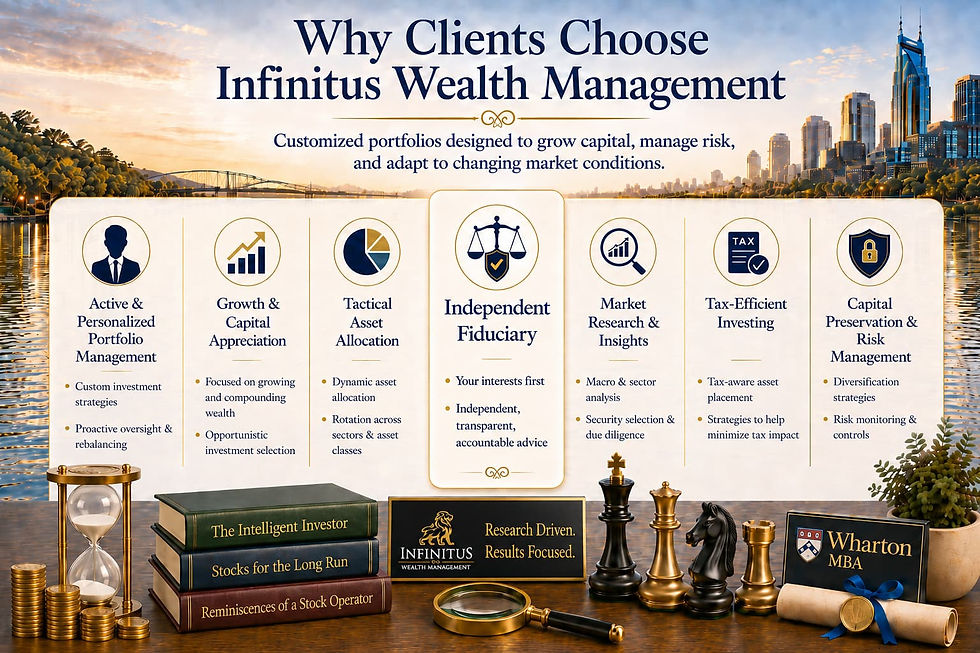
This philosophy is not a feature of our practice — it is the practice. Every Infinitus portfolio is constructed from individual stocks and bonds, selected through our research process and assembled around the client's goals, tax picture, income needs, and time horizon. We run twelve proprietary strategies, and each client's portfolio draws on them in the combination their situation calls for, then stays under active management: positions are watched, theses are re-tested, and the portfolio is adjusted as facts change rather than on a rebalancing calendar.
Because we are a fee-only, independent fiduciary, there is no product to sell you into — only a portfolio to build for you. Investment management clients also receive a complete financial plan as part of the advisory relationship, covered by the same single fee. If you are weighing whether your own portfolio has outgrown its wrappers, the natural first step is an introductory conversation about what a custom portfolio of individual securities would look like built around your situation.
Frequently Asked Questions
Are individual stocks and bonds riskier than mutual funds?
Diversification comes from the number and mix of holdings, not from the wrapper around them. A direct portfolio built across dozens of positions, sectors, and bond maturities is diversified by construction, with single-position exposure managed through sizing. The wrapper never removed risk — it only changed who makes the decisions about it.
How many positions does a diversified direct portfolio hold?
Enough that no single holding can dictate the outcome, and few enough that every holding is there for a researched reason. The practical threshold is whether an account can hold a genuinely diversified set of individual securities across sectors and maturities — which is exactly the question an introductory conversation settles for your specific numbers.
What happens to dividends and interest in a direct portfolio?
They are paid straight into your account by the companies and issuers you own, on their published schedules. From there the cash does what your plan says it should — reinvest into new positions, fund withdrawals, or accumulate toward a purpose — rather than being handled at a pool level you don't direct.
What happens to individual bonds when interest rates change?
Their market prices fluctuate before maturity, just as any bond's do. The difference is the endpoint: held to maturity, an individual bond returns its face value regardless of where rates wandered in between, subject to the issuer's credit. A ladder spreads maturities across several years, so maturing principal is regularly available to reinvest at whatever rates the market then offers.
Does Infinitus ever use mutual funds or ETFs?
We build exclusively with individual stocks and bonds. We never use mutual funds, and reach for an ETF only rarely, when a specific exposure genuinely can't be built better directly. If a portfolio we manage holds something, there is a security-level reason it is there.
Is financial planning included?
Yes — for investment management clients, a complete financial plan is included in the advisory fee, with no separate planning charge. The plan and the portfolio are one piece of work from the same team. New relationships begin with an introductory conversation.

How High-Net-Worth Family Investment Portfolios Are Structured Differently
Wirehouse vs Independent RIA Fees: What's the Real Difference?
Sector Rotation and the Business Cycle: How Smart Money Moves Before the Headlines
What Is Retirement Income Sequencing? Ordering Your Withdrawals with Confidence
Building a Tax-Efficient Retirement Income Strategy Across Multiple Account Types
Independent Fiduciary Advisor vs. Wirehouse Advisor: Which Is Right for You?
Disclosures: Infinitus Wealth Management is a fee-only, independent fiduciary registered investment adviser. This material is provided for informational and educational purposes only and does not constitute investment, legal, or tax advice, an offer to buy or sell any security, or a recommendation of any specific investment, strategy, or account type. Investing involves risk, including the possible loss of principal. Bonds are subject to interest-rate, inflation, and credit risk; a bond's return of face value at maturity depends on the issuer's ability to pay. Diversification does not guarantee a profit or protect against loss in a declining market. Any illustrations in this article are hypothetical, are not drawn from actual client accounts, and do not represent the performance of any Infinitus strategy or client. Past performance is not indicative of future results. Advisory fees are described in our Form ADV Part 2A, available upon request. Please consult your tax professional regarding your individual circumstances before acting on any information presented here.


