
Sector Rotation and the Business Cycle: How Smart Money Moves Before the Headlines


Market leadership shifts long before the news confirms it. Understanding where the cycle stands — and which sectors have historically led each phase — is one of the most durable edges in active investing.
By the time a recovery makes the front page, markets have usually been positioning for it for months. That is the essence of sector rotation — the tendency for leadership to pass from one group of industries to another as the business cycle moves through its phases. Investors who understand sector rotation study where the economy is heading, not where the headlines say it has been, and they adjust portfolio emphasis before the consensus catches up. It is one of the oldest disciplines in professional investing, and one of the most misunderstood by individual investors who only encounter it after the move has already happened.
This article walks through how the business cycle works, which sectors have historically led each phase, why markets consistently move ahead of the economic data, and how a portfolio built from individual stocks and bonds can put this discipline to work with real precision.
Markets don't wait for confirmation. They price what's coming — and leadership rotates accordingly.
What Sector Rotation Is — and Why It Has Persisted
The economy expands and contracts in recognizable, repeating phases. Interest rates rise and fall. Credit loosens and tightens. Consumers spend freely, then carefully, then freely again. Each of those conditions favors certain business models over others — and because every sector of the market is simply a collection of business models, sector performance tends to follow the cycle in patterns that have repeated across decades.
Sector rotation is the practice of tilting portfolio emphasis toward the industries whose fundamentals are improving as the cycle turns, and away from those whose tailwinds are fading. When borrowing is cheap and demand is accelerating, economically sensitive businesses — homebuilders, banks, consumer discretionary companies, industrial manufacturers — see revenue and earnings inflect first. When growth matures and costs rise, pricing power and balance-sheet strength matter more. And when the economy cools, businesses whose demand holds steady regardless of conditions — utilities, health care, everyday consumer staples — have historically shown greater earnings resilience.
None of this requires predicting the future with certainty. It requires understanding where you are. The cycle doesn't repeat on a fixed schedule, but its sequence has been remarkably consistent: expansion, peak, contraction, trough, and expansion again. Investors who can locate the current phase with reasonable confidence hold a meaningful analytical advantage over those who simply react to what already happened.

The Four Phases of the Business Cycle — and Where Leadership Has Lived
Early expansion begins while sentiment is still recovering. Interest rates are typically low, credit conditions are loosening, and pent-up demand starts converting into orders. Historically, this is when economically sensitive sectors have led: financials benefit from steepening yield curves and reviving loan demand, consumer discretionary companies capture the first wave of renewed spending, and small- and mid-cap companies — more domestically exposed and more operationally leveraged — have often outpaced their larger peers.
Mid-cycle is the longest phase, where growth broadens and compounding does its quiet work. Corporate investment picks up, which has historically favored technology and industrials — the sectors that sell productivity to everyone else. Leadership tends to be less dramatic here; execution and earnings quality matter more than raw cyclicality.
Late cycle arrives as capacity tightens. Input costs climb, labor markets run hot, and monetary policy leans against the expansion. Sectors tied to real assets and commodity prices — energy and materials — have historically posted some of their strongest relative performance in this window, while richly valued growth stories become more sensitive to rising rates.
The reset phase — contraction — is where the cycle clears excess and plants the seeds of the next expansion. Demand-resilient sectors like consumer staples, health care, and utilities have historically held up best on a relative basis, because people buy groceries, fill prescriptions, and pay power bills in every economy. Just as importantly for long-term investors, this phase has historically created some of the most attractive entry points of the entire cycle for high-quality businesses. Sector rotation is not only about defense late in the cycle; it is about being prepared to lean into opportunity when others are still reading yesterday's news.

Why Markets Move Before the Headlines
Here is the part most investors underestimate: the stock market is not a scoreboard of the current economy. It is a pricing mechanism for the future one. Every share price reflects a collective estimate of the cash flows a business will generate over the coming years — which means equity prices respond to expectations about the next six to twelve months, not the quarter that just closed.
Economic data, by contrast, describes the past. Employment reports arrive weeks after the month they measure. GDP arrives a full quarter late and gets revised twice. And official cycle dating is slower still — the committee that formally dates U.S. recessions has often made its announcements many months, sometimes more than a year, after the turning point actually occurred. By the time a headline declares the economy has turned, the market has usually known for a long time.
This is why sector rotation rewards preparation over reaction. Historically, equity markets have frequently bottomed while the economic news was still deteriorating, and leadership in early-cycle sectors has often emerged while headlines were at their most cautious. The investors positioned for that turn were not reacting to news. They were reading the forward-looking signals — and acting while conviction was still uncomfortable.
The practical takeaway is encouraging: you do not need to be faster than the news cycle, because the news cycle was never the game. The game is understanding what markets are pricing, comparing it to what the underlying data suggests is coming, and positioning with discipline. That is research work — the kind an active portfolio management process is built to do every day.

The Signals Professional Investors Watch
If headlines lag, what leads? Professional investors triangulate across a set of forward-looking indicators that have historically shifted before the broad economy does. No single signal is decisive; the discipline lies in reading them together.
The yield curve. The relationship between short- and long-term interest rates compresses market expectations about growth and policy into a single picture. Its shape — steepening, flattening, inverting, re-steepening — has historically carried information about where the cycle stands.
Credit spreads. The extra yield investors demand to hold corporate bonds over Treasuries is a real-time vote on business health. Tightening spreads have historically signaled improving confidence; widening spreads have signaled stress building beneath the surface — often before it appears in earnings.
Purchasing manager surveys and new orders. Surveys of the people who actually place orders for materials and equipment turn before production data does, because orders precede output by definition.
Market leadership itself. Rotation is both the strategy and a signal. When early-cycle sectors begin outperforming during a downturn, or defensive sectors quietly take the lead during an expansion, the market is telling you what it expects next.
Reading these signals well is a research discipline, not a newsletter subscription. It means tracking the data continuously, understanding what each indicator has and hasn't reliably signaled in past cycles, and having the judgment to act when the evidence accumulates — which is precisely the work a dedicated investment team exists to do. This is also where sector rotation connects to security selection: identifying the right sector is only half the job. Owning the strongest individual businesses within that sector is the other half.

Why Individual Stocks and Bonds Are Built for Sector Rotation
Here is where portfolio structure matters more than most investors realize. Applying sector rotation through pooled products is a blunt instrument: buying a fund means buying every holding inside it — the sector's strongest operators and its weakest, in whatever proportions the fund dictates. You get the category, not the conviction.
A portfolio built from individual stocks and bonds works differently. When cycle analysis points toward increasing emphasis on, say, industrials, an active manager can select the specific companies with the strongest balance sheets, the most durable order books, and the best positioning for that phase — and size each position deliberately. When the cycle matures, that emphasis can be trimmed with the same precision, position by position, with full visibility into the tax consequences of every decision. On the fixed income side, individual bonds allow duration and credit exposure to be tuned to the cycle directly, rather than accepting whatever a bond fund happens to hold.
This precision is the reason Infinitus builds client portfolios exclusively from individual securities. Our twelve proprietary strategies are the building blocks — from dividend income growth to small- and mid-cap growth — and cycle analysis informs how those building blocks are weighted and how securities are selected within them. Sector rotation, in this structure, is not a product you buy. It is a discipline embedded in how the portfolio is researched and managed every day, alongside the risk management that keeps positioning aligned with each client's goals.
It is also a discipline that benefits from independence. A fee-only fiduciary structure means positioning decisions are driven by research and client outcomes — there are no product commissions, fund revenue-sharing arrangements, or house inventory shaping what ends up in your portfolio.
Putting Sector Rotation to Work — With Discipline, Not Drama
A final word on temperament, because it matters as much as the analytics. Sector rotation done well is measured, incremental, and evidence-driven. It is not lurching the entire portfolio from one theme to another, and it is not a license to trade constantly. The most successful cycle-aware investors make deliberate tilts around a durable core of high-quality businesses, let the evidence accumulate before acting, and accept that they will be early sometimes — because being early with a sound thesis has historically been a far better position than being late with a certain one.
The business cycle will keep turning. Leadership will keep rotating. And the headlines will keep arriving after the fact, as they always have. The opportunity belongs to investors who treat that lag not as a frustration but as a structural advantage — one that disciplined research, precise portfolio construction, and a long-term temperament are built to capture.
Frequently Asked Questions
What is sector rotation?
Sector rotation is the tendency for market leadership to shift among sectors of the economy as the business cycle moves through its phases. Different industries have historically performed best at different points in the cycle, and investors who study those patterns adjust portfolio emphasis as conditions evolve rather than waiting for headlines to confirm the change.
How does the business cycle affect sector performance?
Each phase — early expansion, mid-cycle, late cycle, and contraction — creates different conditions for revenue growth, borrowing costs, and consumer behavior. Historically, economically sensitive sectors have tended to lead early in expansions, while more stable, demand-resilient sectors have tended to hold up better as growth slows. Past patterns are not guarantees of future results.
Why do markets move before economic headlines?
Markets are forward-looking pricing mechanisms. Prices reflect expectations about the next six to twelve months, while economic data is reported with a lag and official cycle dating often arrives many months after the fact. Historically, equity markets have frequently turned before the data — and well before the headlines — confirmed a change in direction.
Can individual investors use sector rotation?
Yes, though it requires research discipline: tracking leading indicators, understanding where the cycle stands, and owning securities that can be adjusted with precision. Portfolios built from individual stocks and bonds allow position-level control that pooled vehicles cannot offer, which is one reason many investors work with an active manager for this discipline.
How does Infinitus Wealth Management apply sector rotation?
Infinitus builds custom portfolios exclusively from individual stocks and bonds, actively managed on a discretionary basis. Cycle analysis and sector positioning inform how our research team weights industries and selects securities within each client's custom portfolio, always in the context of that client's goals, time horizon, and risk parameters.
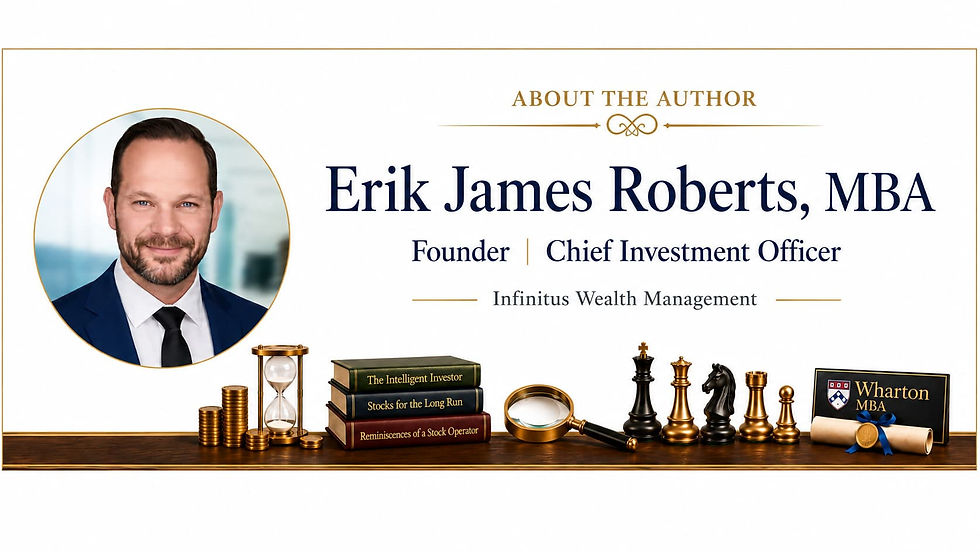
About the Author: Erik Roberts is the Founder and Chief Investment Officer of Infinitus Wealth Management, a fee-only independent fiduciary firm in Nashville, Tennessee. A veteran of the 101st Airborne Division and a Purple Heart recipient, Erik holds an MBA from the Wharton School and spent years working in equity research and as a financial advisor before founding Infinitus. He leads the research behind the firm's twelve proprietary strategies and personally directs the construction of every client portfolio from individual stocks and bonds.


The High-Net-Worth Wealth Management Checklist for Families With $5M to $25M
Managing Portfolio Risk When Your Income and Stock Are Tied to One Company
Generating Income with Stock Options: Strategies and Insights
Navigating Tax Implications for High Net Worth Individuals: Strategies to Reduce Your Taxes
Important Disclosures
Infinitus Wealth Management is a registered investment advisory firm. This article is provided for educational and informational purposes only and does not constitute investment, tax, legal, or accounting advice. It is not an offer or solicitation to buy or sell any security or to enter into any advisory relationship. Any references to specific strategies, withdrawal rates, tax provisions, or historical figures are general in nature and may not be appropriate for any individual investor.
Past performance is not indicative of future results. All investing involves risk, including the possible loss of principal. Tax laws are complex, change frequently, and have unique application to individual circumstances; please consult a qualified tax professional regarding your specific situation. Social Security rules, Medicare rules, and retirement account regulations are subject to legislative and regulatory change.
The information in this article was believed to be accurate at the time of writing but is not guaranteed. Readers should consult with their own qualified advisors before making any financial decisions specific to their situation.


