
Accredited Investor Requirements 2026: Do You Qualify?


Erik James Roberts — Founder & CIO, Infinitus Wealth Management. Purple Heart recipient, Wharton MBA.
Updated October 1, 2026
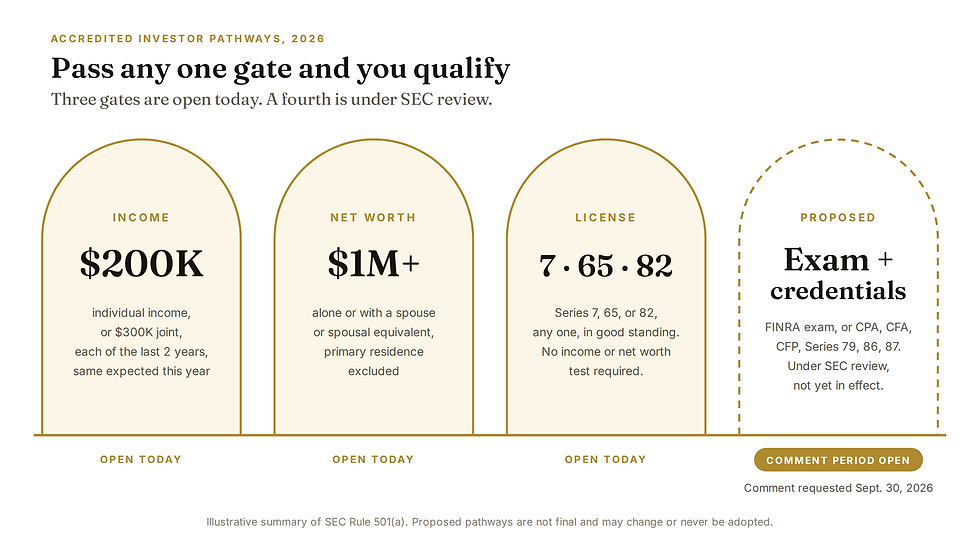
Accredited investor requirements in 2026 come down to passing one of three tests: annual income above $200,000 (or $300,000 together with a spouse or spousal equivalent) in each of the last two years with the same expected this year, net worth above $1 million not counting your primary residence, or holding a qualifying professional license such as the Series 7, Series 65, or Series 82. If you clear any one of those bars, you qualify. The dollar thresholds have not moved since 1982, and the SEC's September 30, 2026 vote did not change them. What the SEC did do is open a comment period on two new ways in: a FINRA-administered exam and a list of professional credentials including the CPA, CFA, and CFP. This article walks through each test, the calculation details that trip people up, what the proposed changes would mean, and the question that matters more than the label: whether being accredited should change how you invest.
What Are the Accredited Investor Requirements in 2026?
The accredited investor requirements live in Rule 501 of Regulation D, the part of federal securities law that lets companies and funds raise money without registering the offering with the SEC. Private equity funds, venture capital funds, hedge funds, private credit vehicles, real estate syndications, and pre-IPO share sales almost all rely on these exemptions, which is why they ask for proof of accredited status before accepting your money. The definition is the government's rough proxy for "this person can evaluate the risk and absorb the loss."
For individuals there are three ways through the gate.
The income test. You need individual income above $200,000 in each of the two most recent calendar years, or joint income above $300,000 with your spouse or spousal equivalent, plus a reasonable expectation of reaching the same level in the current year. Income is read broadly: salary, bonus, self-employment income, business distributions, investment income, capital gains, and rental income all count. The two-year lookback is the detail to watch. A record year followed by a normal year does not qualify. Two strong years in a row does.
The net worth test. You need net worth above $1 million, alone or jointly with a spouse or spousal equivalent, excluding the value of your primary residence. Net worth means total assets minus total liabilities. Brokerage accounts, retirement accounts, business ownership interests, rental properties, vehicles, and cash all count on the asset side. Every debt counts on the liability side, with one carve-out explained below.
The professional license test. Since 2020, anyone holding a Series 7 (general securities representative), Series 65 (investment adviser representative), or Series 82 (private securities offerings representative) license in good standing qualifies regardless of income or net worth. The SEC added this pathway on the theory that demonstrated financial knowledge is at least as good a proxy for sophistication as a bank balance. It is the foundation for the much larger expansion now under consideration.
A few narrower pathways also exist. Directors, executive officers, and general partners of the company doing the offering are accredited for that offering. "Knowledgeable employees" of a private fund are accredited for that fund. And on the entity side, trusts, LLCs, family offices, and other entities with more than $5 million in assets or investments qualify, as does any entity in which every equity owner is individually accredited.
How Do You Calculate Net Worth for the Accredited Investor Test?
The primary residence exclusion is where most of the real questions come from, so here is how it works in practice.
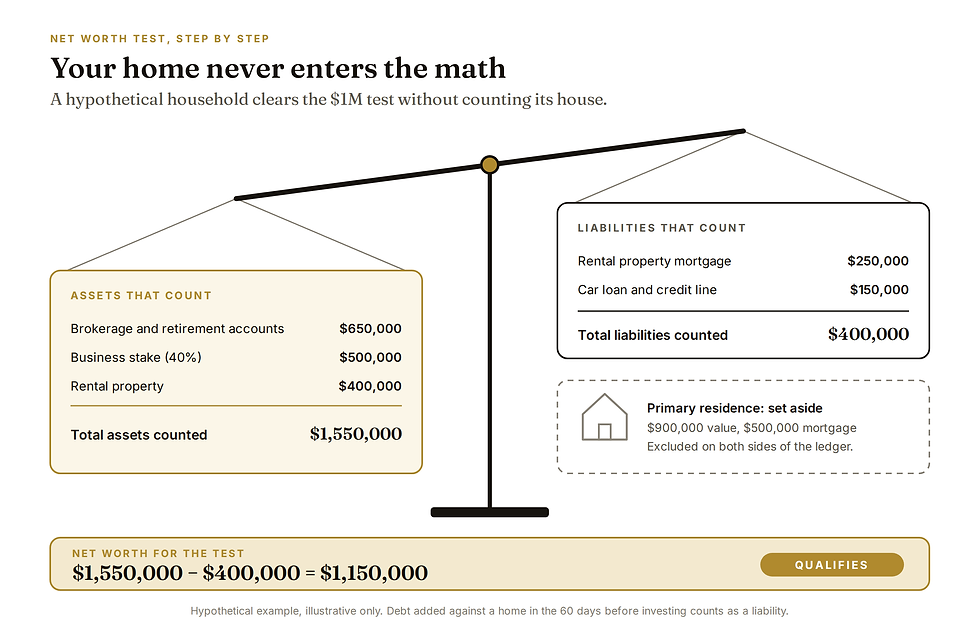
Your home's value is excluded from assets. The mortgage on it is also excluded from liabilities, up to the home's fair market value. That symmetry is deliberate: the SEC did not want a paid-off house to count in your favor, and did not want a mortgage to count against you either.
Two exceptions pull the mortgage back in. First, if you owe more on the home than it is worth, the underwater portion counts as a liability. Second, if you increased the debt on your home in the 60 days before buying the private investment (a cash-out refinance or a new home equity line, for example), that increase counts as a liability even if the home has plenty of equity. The 60-day rule exists so nobody can borrow against their house to manufacture qualifying net worth.
A worked example makes it concrete. Suppose you hold $650,000 across brokerage and retirement accounts, own a 40 percent stake in a business worth $500,000, have a rental property worth $400,000 with a $250,000 mortgage, and live in a $900,000 home with a $500,000 mortgage. Your $150,000 in other debt includes a car loan and a credit line. Assets that count: $650,000 + $500,000 + $400,000 = $1,550,000. Liabilities that count: $250,000 + $150,000 = $400,000. Net worth for the test: $1,150,000. You qualify, and the house never entered the math.
Joint calculations include the assets and liabilities of a spouse or spousal equivalent, which the SEC defines as a cohabitant occupying a relationship generally equivalent to that of a spouse. You do not need to hold assets jointly; you only need to add them up jointly.
How Could Accredited Investor Requirements Change After the SEC's September 30 Vote?
On September 30, 2026, the SEC voted on a package of private-market proposals and separately asked the public to comment on two new ways to qualify as an accredited investor. Neither is law yet. The comment periods run 60 days from publication in the Federal Register, and a final rule would come later. Here is what is on the table.
An accredited investor exam. The SEC is asking whether passing a test developed by FINRA (the Financial Industry Regulatory Authority, the self-regulatory body that licenses brokers) should qualify someone as accredited with no income or net worth requirement. According to SEC staff at the open meeting, the exam would cover securities structures, investment risk, disclosure, and the regulatory framework, and a passing result would be valid for ten years. If adopted, it would be the first broad knowledge-based route into private markets for someone who is not already a licensed professional.
Additional professional credentials. The SEC is also considering designating the following as qualifying on their own: a U.S. CPA license, the CFA charter, the CFP certification, the Series 79 investment banking license, and the Series 86 and 87 research analyst licenses. Anyone holding one of these in good standing would qualify the same way Series 7, 65, and 82 holders do today.
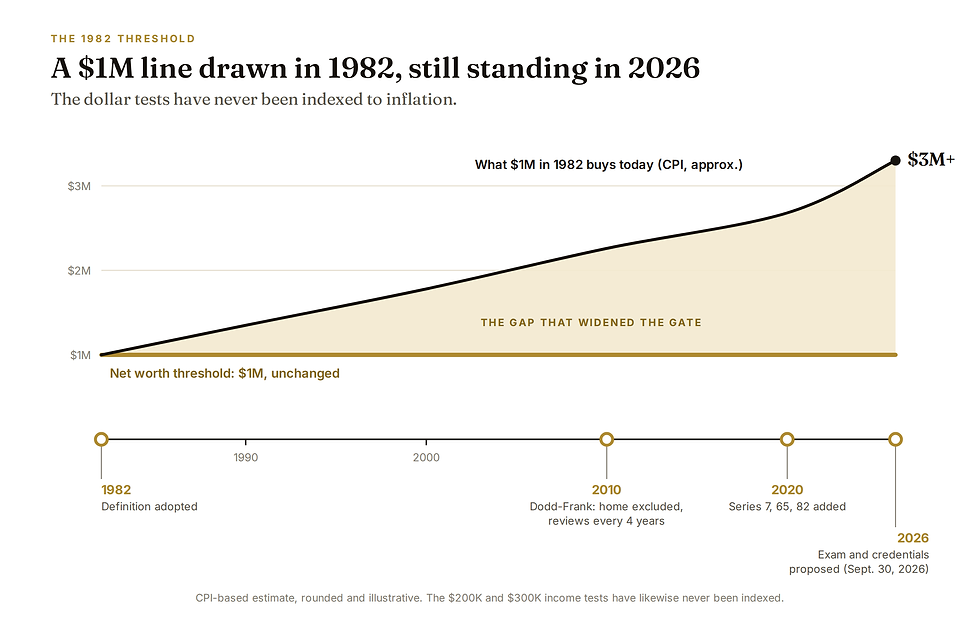
What is not on the table is a change to the dollar figures. The $200,000, $300,000, and $1 million thresholds were set in 1982 and have never been indexed to inflation. One million dollars in 1982 is worth more than $3 million in today's purchasing power, which is why the accredited population has grown from a small single-digit share of U.S. households in the early 1980s to a far larger share now. Congress asked the SEC through Dodd-Frank to review the definition every four years, and every review so far has left the numbers alone. The direction of travel in 2026 is clearly toward widening the gate, not narrowing it.
For Infinitus clients, the practical takeaway is simple. If you qualify today under income or net worth, nothing changes. If you are a CPA, CFA charterholder, or CFP who does not yet meet the financial tests, you may have a new path within the next year or two. And if the exam pathway is adopted, accredited status will become something you can study for rather than something you have to wait for.
Do Accredited Investor Requirements Mean You Should Invest in Private Markets?
Meeting the accredited investor requirements is a legal eligibility threshold. It is not an investment recommendation, and it is not a signal that your portfolio is missing something. This is the point I spend the most time on with new clients, because the marketing around private markets is designed to make the gate feel like a velvet rope.
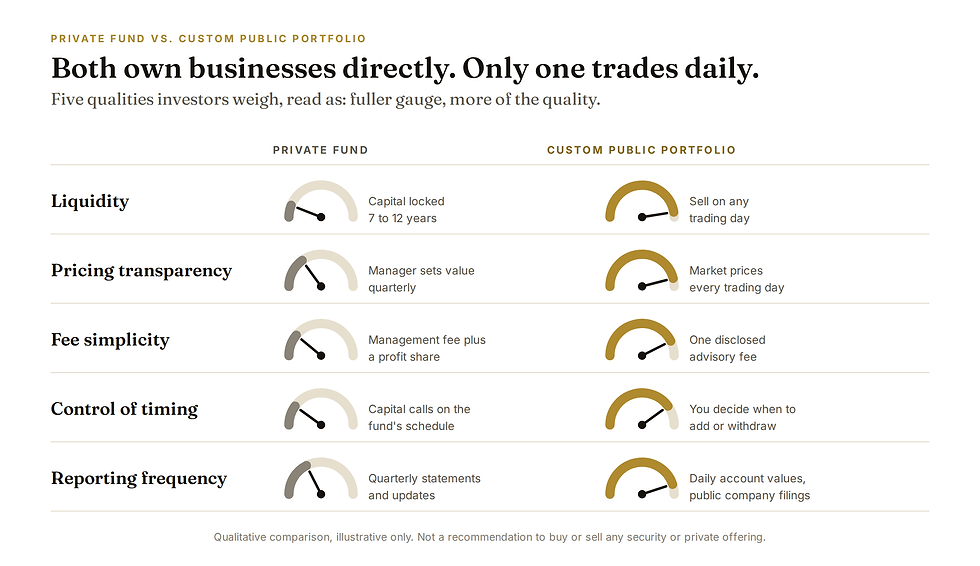
Here is how I think about it as a chief investment officer. The appeal of private equity, venture capital, and private credit is real: direct ownership of businesses, return streams that look different from the index, and the sense of being in the room. But those features come bundled with costs that are easy to underweight. Private funds commonly charge a management fee near 2 percent plus 20 percent of profits. Capital is commonly locked for seven to twelve years, with capital calls arriving on the fund's schedule rather than yours. Valuations are set quarterly by the manager rather than daily by the market, which makes volatility look lower than it is. And the dispersion between top-quartile and bottom-quartile managers is enormous, so the average experience is far less compelling than the headline numbers suggest.
Most of what investors hope to get from private markets is available in public markets with daily liquidity, transparent pricing, audited financials, and a single transparent fee. Owning individual companies directly through a custom portfolio gives you direct ownership of businesses. Concentrating in a researched set of individual securities gives you returns that do not simply track an index. And a fee-only fiduciary structure means every dollar of cost is disclosed on one line.
That is the model at Infinitus. We build custom portfolios from individual securities, researched and selected one position at a time, across twelve proprietary strategies. Our advisory fee is 1.00 percent at the first tier and steps down to 0.95, 0.90, and 0.80 percent as assets grow, with no fund-level fees layered underneath because there are no funds. Accredited and non-accredited clients receive the same process. The label on your subscription documents does not change how we research a company or construct a portfolio.
None of this means private markets are never appropriate. For a client with substantial liquidity elsewhere, a long horizon, and a specific reason to own a particular private asset, an allocation can make sense, and we help clients evaluate those opportunities with the same rigor we apply to a public company. The point is that the accredited investor requirements open a door. They do not tell you whether to walk through it.
What Else Should You Know About Accredited Investor Status?
A few related questions come up constantly, so here are the short answers.
Verification. In a Rule 506(b) offering, the issuer can rely on your written representation that you are accredited. In a Rule 506(c) offering, which allows general advertising, the issuer must take reasonable steps to verify your status. In practice that means providing tax returns or W-2s for the income test, account and credit statements for the net worth test, or a verification letter from a CPA, attorney, registered broker-dealer, or SEC-registered investment adviser. Infinitus can provide verification letters for clients who need them, and we can connect you with a CPA or securities attorney if you do not already have one.
Accredited investor vs. qualified purchaser. A qualified purchaser is a higher bar: an individual with at least $5 million in investments, or an entity with $25 million. Some private funds limit themselves to qualified purchasers so they can accept more than 100 investors without registering as an investment company. If you see a fund that requires qualified purchaser status, that is why.
Retirement accounts. Assets in an IRA or 401(k) count toward net worth. Many self-directed IRA custodians will hold private investments, but the tax and liquidity consequences deserve a careful look before you commit retirement dollars to something you cannot sell.
State rules. Some states layer their own requirements onto certain offerings, and a few private placements set minimums above the federal definition. Always read the subscription agreement.
Frequently Asked Questions About Accredited Investor Requirements
What are the accredited investor requirements in 2026?
You qualify by meeting any one of three tests: individual income above $200,000 (or $300,000 jointly) in each of the last two years with the same expected this year; net worth above $1 million excluding your primary residence; or holding a Series 7, 65, or 82 license in good standing. The thresholds are unchanged from prior years.
Does my house count toward the $1 million net worth requirement?
No. Your primary residence is excluded from assets, and the mortgage on it is excluded from liabilities up to the home's value. Only an underwater mortgage balance or debt added against the home in the 60 days before the investment counts against you.
Did the SEC change the accredited investor definition in September 2026?
Not yet. On September 30, 2026, the SEC voted to request public comment on adding a FINRA-administered exam and additional credentials (CPA, CFA, CFP, Series 79, Series 86/87) as new pathways. The comment period runs 60 days after Federal Register publication, and any change would require a final rule.
Can I combine my income with my spouse's to qualify?
Yes. The joint income test is $300,000 in each of the last two years, and the joint net worth test is $1 million. "Spousal equivalent" also counts, meaning a cohabitant in a relationship generally equivalent to marriage.
Do I have to be accredited to work with Infinitus Wealth Management?
No. Infinitus builds custom portfolios of individual securities for accredited and non-accredited clients alike. Accredited status only affects eligibility for certain private offerings, not how we research and manage your portfolio.
Is being an accredited investor the same as being a qualified purchaser?
No. Qualified purchaser is a higher threshold, generally $5 million in investments for an individual. Funds that limit themselves to qualified purchasers do so to hold more than 100 investors without registering as an investment company.
Whether you qualify as accredited today or expect to soon, the next step is the same: an introductory conversation about what a custom portfolio built for your situation would look like.

Independent Fiduciary Advisor vs. Wirehouse Advisor: Which Is Right for You?
Wirehouse vs Independent RIA Fees: What's the Real Difference?
Managing Portfolio Risk When Your Income and Stock Are Tied to One Company
Executive Compensation: Stock Options, Restricted Stock, and Deferred Compensation Plans
Infinitus Wealth Management, LLC is a fee-only, independent registered investment adviser. This article is for educational and informational purposes only and does not constitute investment, legal, tax, or accounting advice, nor an offer or solicitation to buy or sell any security or to participate in any private offering. Accredited investor status is determined under SEC Rule 501 of Regulation D; proposed amendments described here are not final and may change or never be adopted. Consult a qualified securities attorney or CPA regarding your eligibility. All examples are hypothetical and for illustration only. Investing involves risk, including possible loss of principal. Private investments carry additional risks, including illiquidity, limited transparency, and loss of the entire investment. Past performance does not guarantee future results. Fee tiers are described in Infinitus's Form ADV Part 2A, available upon request.


