
The Truth Behind Low-Fee Financial Advisors: What Do You Actually Get?


Erik James Roberts — Founder & CIO, Infinitus Wealth Management. Purple Heart recipient, Wharton MBA.
Updated October 28, 2026
Low-fee financial advisors charge between nothing and about 0.35% a year because the service is built around software rather than a person: an algorithm selects your funds, a computer rebalances them, and the human you reach by phone is there to talk about your plan, not to manage your portfolio. That is not a criticism. It is simply what the product is, and every one of these firms says so in its own Form ADV brochure, the disclosure document each registered adviser files with the SEC.
I have sat across the table from a lot of people who were weighing a low-fee firm against a firm like mine. Almost every one of them led with the fee. Almost none of them knew what the fee was paying for. This article is the conversation I wish they'd had before they walked in, and it is built entirely from what the firms themselves disclose.
I'm Not Saying This Is Bad
Some people want an algorithm making every investment decision, and that is a perfectly reasonable choice. The software is good, the funds are cheap, and the price is hard to beat. If that is what you want, you should know exactly what you're getting and pay as little as possible for it.
Some people want a steak burrito from Taco Bell, and some people want a steak from Peter Luger. Both are steak. They are not the same meal, and nobody confuses the price of one for the other. The problem is that in investing, the menus look alike. "Financial advisor" appears on both, and the difference only shows up when you read the fine print.
So here is the fine print.
What Low-Fee Financial Advisors Actually Offer
Every major low-fee platform runs on the same structure. You answer a questionnaire. An algorithm matches you to one of its pre-built allocations. The allocation is filled with the firm's own funds or a short list of ETFs. Software monitors the drift and rebalances when it crosses a threshold. If you pay for the tier with a human, that human helps you set goals and answers questions by phone or video.
The firms describe it plainly:
Vanguard: "Ultimately any trading and investment decisions within your Enrolled Accounts will be made by our algorithms." (Digital Advisor and Personal Advisor brochure, p. 65)
Fidelity Go: "We use a proprietary algorithm to identify one in a series of long-term asset allocation strategies." (Fidelity Go brochure, p. 16)
Wealthfront: "Wealthfront Advisers is an automated investment adviser registered with the SEC." (Form ADV Part 2A, Item 4)
Schwab: "SIP is an automated discretionary investment advisory service." (Schwab Intelligent Portfolios brochure, p. 3)
Betterment: "Our software generates recommendations and, for managed portfolios, constructs and manages portfolios." (Form ADV Part 2A, p. 21)
Nothing in those sentences is hidden. They are in the first few pages of each brochure. Most clients just never open the brochure.

Who Picks Your Investments?
At a low-fee firm, the answer is a model. The algorithm chooses an allocation, and the allocation is filled from a fixed menu. In most cases the menu is the firm's own products.
Vanguard's Form CRS states that its recommendations "will generally only include Vanguard exchange traded funds and mutual funds, and will generally not include purchases of individual securities or bonds." The all-index option is four Vanguard ETFs. Schwab's brochure says "CS&Co. has instructed CSIM to select or retain Schwab ETFs in the portfolios." Fidelity Go portfolios are "composed of Fidelity Flex mutual funds," which are Fidelity's own.
Even where a human has a title that sounds like portfolio management, the brochure usually clarifies the role. At Fidelity Wealth Management, your dedicated representative handles planning and the relationship, while a separate entity, Strategic Advisers LLC, Fidelity's central investment team, maps your account to one of its strategies and manages the funds for everyone in that strategy at once. Empower, which does use individual stocks, says its "investment analysis emphasizes asset allocation research and portfolio diversification techniques over individual security analysis," and that holdings come from "the designated model portfolio."
None of that is a flaw. A model is how you serve millions of accounts at 0.25%. It just means nobody is choosing holdings with your name on the file.
Who You Can Actually Reach (a Toll-Free Number?)
This is the part people are most surprised by, because the word "advisor" suggests a person with an office and a direct line.
Vanguard's brochure is specific. Retail brokerage clients in Personal Advisor "are assigned to a team of VAI Financial Advisors" and book time "by logging in to the Site and scheduling a convenient time for the VAI Financial Advisor to call them, or by calling us at 877-662-7447." NerdWallet's review of the service reports that clients meet their advisor "by phone, email, video or through Vanguard's mobile app," and that "Vanguard does not offer in-person meetings." Across 128 pages of the brochure, an in-person meeting is never mentioned.
Betterment Premium clients "are likely to interact with multiple financial consultants." Fidelity Go provides "a team of phone-based representatives for one-on-one financial coaching," and its brochure states the service does "not include in-person or in-branch" planning. Empower's advisors "are accessible via telephone, email, or by video conference." Wealthfront makes representatives available "to discuss servicing matters."
Fidelity Wealth Management and Schwab Wealth Advisory are the two exceptions. Both have physical branches where a dedicated advisor can meet you in person. Both also cost more than the rest of this list, and in both cases the investment decisions still come from a central model.
After reading every one of these brochures, here is what stood out to me. Not one of them describes an office you can walk into. Not one of them gives you a direct line to the person advising you. Every one describes the same path: a main number, a scheduling page, a call. Main number, scheduling queue, no office to visit. To me that reads like a call center. You can decide what it reads like to you.

Is Anyone Watching Your Portfolio?
Here is the question I'd ask any advisor before hiring them: between our meetings, is a person looking at my account?
For the low-fee firms, the brochures answer it.
Betterment: "Financial consultants do not monitor client accounts in between consultations."
Vanguard, in the section on algorithm risk: "The algorithms don't consider prevailing market conditions when making recommendations to you," and "while we oversee the algorithms on an ongoing basis, your Enrolled Accounts or Portfolio are not monitored unless it is identified as part of testing or monitoring processes."
Schwab: "Investment advisory personnel of CSIM oversee the Rebalancing Algorithms." They watch the algorithm. The algorithm watches you.
Fidelity Go: the coaching team is "not obligated to provide ongoing financial planning advice."
Two more structural points belong here. Vanguard's Personal Advisor Select, its $500,000 tier, is non-discretionary: "VAI does not exercise discretionary investment authority over your Portfolio," and "all transactions are executed only with your prior approval." Schwab Wealth Advisory is also non-discretionary; its advisors make recommendations "but do not have authority to make investment decisions." In both cases, the client is the one making the call on every trade. Many people in those programs don't realize that is the arrangement they signed.

Where the Low Fee Comes From
A 0.25% fee doesn't cover a human. The firms make up the difference in ways they disclose clearly.
The portfolio is the product catalog. When Vanguard fills your account with Vanguard funds and Schwab with Schwab ETFs, the firm earns fund revenue on top of, or instead of, the advisory fee. Vanguard's brochure describes crediting that fund revenue against the gross fee, which is how a 0.35% gross fee becomes roughly 0.31% net.
Cash is a profit center. Schwab charges no advisory fee for Intelligent Portfolios "in part because of the revenue Schwab Bank generates" on the cash sleeve, which "will generally range from 6% to 30% of an account's value." The brochure adds: "The higher the Cash Allocation and the lower the interest rate paid to clients, the more Schwab Bank earns," and "under certain market conditions, the Cash Allocation results in lower overall portfolio performance." Vanguard sweep clients "receive a lower yield on deposits under the bank sweep." Betterment's Form CRS says the firm "has a financial incentive to set a higher cash allocation."
Advisors are paid to keep assets, not to manage them. Vanguard scores its advisors partly on "the percentage of Clients who unenrolled" and "the amount of assets that existing clients retain in the service." Empower's representatives earn incentive pay "based, in part, on funded net asset accumulation and retention," with Personal Strategy in the product grade that provides "the highest bonus compensation."
Again, none of this is secret. It is the business model, and it works at scale. It is also why the fee can be low.
When You Want a Person, the Price Changes
The moment you move from the software tier to a human tier at these same firms, "low fee" stops describing them.
Betterment Premium: 0.65%, for a planning team that doesn't monitor your account between calls.
Empower: 0.89% on the first $1 million, dedicated planner above $250,000.
Schwab Wealth Advisory: 0.80% on the first $1 million, $500,000 minimum, non-discretionary.
Fidelity Wealth Management: 1.50% on the first $500,000, then 1.25%, 1.10%, 0.90% and down, before a credit for Fidelity fund fees.
Those are the prices of a human at a low-fee firm, and in every case the human is a planner sitting on top of a model. Schwab recently retired Intelligent Portfolios Premium, its attempt at a cheap hybrid of software plus a planner, which tells you something about how well that combination held up.
So the real comparison is not 0.25% versus 1.00%. It is what each price buys.

Low-Fee Financial Advisors Side by Side
Firm and tier | Minimum | Fee | In-person office | Reached through a main number | Human advisor | A person actively managing your portfolio |
Vanguard Digital Advisor | $100 | ~0.15% net | No | Yes | None | No |
Vanguard Personal Advisor | $50,000 | ~0.31% net | No | Yes | Financial planning team, by phone | No |
Vanguard Personal Advisor Select | $500,000 | 0.30% | No | Yes | Financial planner, dedicated if you qualify, otherwise a pool | No. You approve each trade. |
Vanguard Wealth Management | $5 million | 0.30% to 0.05% | No | Yes | Dedicated financial planner (CFP) + planning team | No |
Wealthfront | $500 | 0.25% | No | Yes | None | No |
Betterment Digital | $0 | 0.25% | No | Yes | None | No |
Betterment Premium | $100,000 | 0.65% | No | Yes | Financial planning team, by phone or video | No |
Fidelity Go | $0 | 0.35% above $25,000 | No | Yes | Financial coaching team, by phone | No |
Fidelity Advisory Services | $50,000 | 1.10% gross, less credit | No | Yes | Financial planning team, by phone | Partial: central team manages the model |
Fidelity Wealth Management | ~$500,000 | 1.50% to 0.50% gross, less credit | Yes | No | Dedicated financial planner + service team | Partial: central team manages the model |
Empower Investment Services | $100,000 | 0.89% | No | Yes | Financial planning team | Partial: systematic model picks holdings, advisor team monitors |
Empower Wealth Management | $250,000 | 0.89% | No | Yes | Dedicated financial planner | Partial: systematic model picks holdings, advisor monitors |
Empower Private Client | $1 million | 0.79% to 0.49% | No | Yes | Dedicated financial planner + specialists | Partial: systematic model picks holdings, advisor monitors. |
Schwab Intelligent Portfolios | $5,000 | 0%, with 6% to 30% held in cash | Service only | Yes | None | No |
Schwab Wealth Advisory | $500,000 | 0.80% to 0.30% | Yes | No | Dedicated advisor who recommends from Schwab's models | Partial. You approve each trade. |
Infinitus Wealth Management | Under $1M-1.00% $1M to $4.99M-0.95% $5M to $9.99M-0.90% $10M+-0.80% | 0.80%-1.00% | Yes | No, direct line to advisor | The CIO, who builds and manages your portfolio and does your planning | Yes, active portfolio management |
Every row above comes from the firm's own Form ADV brochure or service agreement, quoted in the sections above. Figures are from each firm's published materials as of the date of this article and are subject to change. This is a comparison of service models, not a recommendation of any firm.
What a Portfolio Built by a Person Looks Like
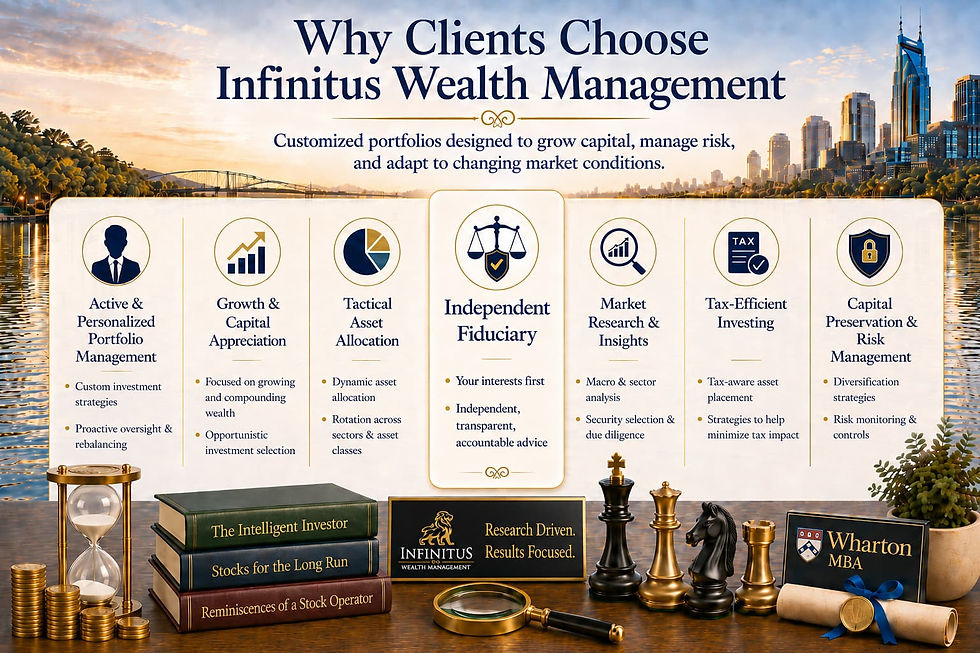
At Infinitus, I am the person. I hold a Wharton MBA, I serve as the firm's Chief Investment Officer, and I build each client's portfolio holding by holding around their goals, their tax picture, and their risk tolerance. I manage it on a discretionary basis, which means I am watching it and acting on it between our meetings, not waiting for you to approve a trade. I also do your financial planning, so the person who knows your plan and the person managing your money are the same person. You can reach me directly, by phone, by video, or in person, from anywhere in the country.
The fee for that starts at 1.00% and steps down as assets grow, with no fund expense layer stacked on top, because there is no fund menu. Your assets are held in your name at Altruist, an independent custodian. I earn no commissions and no product revenue, so the only way I am paid is the fee you can see on your statement.
That caliber of investment management, a Wharton-trained CIO building your portfolio by hand, is usually found behind private bank minimums of $10 million to $25 million. At those firms you typically meet a relationship manager while the investment decisions are made by a committee you never see. At Infinitus you meet the person making the decisions, and the door is open well below that line.
If you want an algorithm, the firms above do it well and I'd tell you so. If you want a person, the fee is higher, and this is what it buys. Either way, you should know which one you're ordering.
Want to see how your current portfolio compares?
Frequently Asked Questions
Are low-fee financial advisors bad?
No. They are well-built software products with cheap funds, and for many investors they are the right choice. The important thing is to understand that the fee buys an algorithm and, at higher tiers, a planner by phone, not a person managing your specific portfolio.
Who picks the investments at a robo-advisor?
An algorithm matches you to a pre-built allocation, and the allocation is filled from the firm's fund menu, often its own funds. Vanguard's brochure states that trading and investment decisions "will be made by our algorithms."
Can I meet with a Vanguard advisor in person?
Vanguard's brochure describes contact by phone and email, and an in-person meeting is never mentioned in its 128 pages. NerdWallet's review states plainly that "Vanguard does not offer in-person meetings." Retail Personal Advisor clients are assigned to a team and schedule calls through the website or the main number.
Does a dedicated advisor at a low-fee firm manage my portfolio?
Generally no. At the firms reviewed here, the dedicated advisor handles planning and the relationship while a model or a central investment team manages the holdings. Betterment's brochure states its consultants "do not monitor client accounts in between consultations."
What does non-discretionary mean?
It means the adviser can recommend trades but cannot make them without your approval. Vanguard Personal Advisor Select and Schwab Wealth Advisory are both non-discretionary, so the client makes the final decision on every transaction.
Why does Infinitus charge more than a robo-advisor?
Because a person is doing the work. The fee covers a Wharton-trained CIO building and managing your portfolio on a discretionary basis, plus your financial planning, with no fund expense layer and no product revenue. Whether that is worth the difference depends on what you want from an advisor.

Infinitus Wealth Management LLC is a registered investment adviser. Registration does not imply a certain level of skill or training. This article is for general informational purposes only and is not individualized investment, tax, or legal advice. All investing involves risk, including the possible loss of principal, and there is no assurance any investment strategy will achieve its objectives. Past performance is not indicative of future results.
Statements about other firms are quoted from or based on those firms' publicly available Form ADV Part 2A brochures, Form CRS, service agreements, and published materials as of the date of this article. Those terms are subject to change, and readers should consult each firm's current disclosures. This article compares service models and fee structures; it does not compare investment performance and is not a recommendation of any firm or service. Infinitus Wealth Management has no affiliation with any firm named. Fees for Infinitus are described in the firm's Form ADV Part 2A, available on request. Client assets are held by Altruist Financial LLC, member FINRA/SIPC, an unaffiliated qualified custodian.


