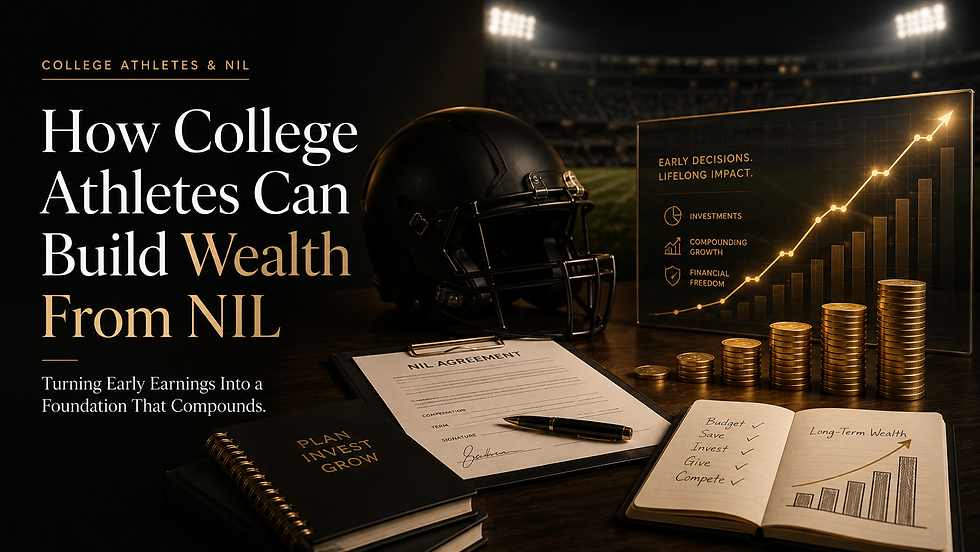
How College Athletes Can Build Wealth From NIL: Turning Early Earnings Into a Foundation That Compounds


Most NIL advice stops at budgets and tax forms. This guide is about the bigger opportunity. Learning how to build wealth from NIL — not just manage it — is the difference between an athlete whose earnings end with their eligibility and an athlete whose college years quietly fund the next fifty. NIL money is real income, but its greatest value isn't what it buys today. It's what it becomes when a 19-year-old puts it to work with four, five, six decades of compounding ahead.
That's a position no other investor in America occupies. The executive earning her peak income at 52 would trade almost anything for the runway you have right now. When you build wealth from NIL, you're not just saving money — you're converting the shortest-lived asset you'll ever own, your college eligibility, into the longest-lived one: time in the market.
The Rookie Investor's Edge: Why Building Wealth From NIL Starts With Time
Compounding is simple: your money earns returns, then those returns earn returns. What makes it extraordinary is duration — growth accelerates the longer it runs, which means the earliest dollars in a portfolio end up doing wildly disproportionate work. A college athlete investing at 19 isn't slightly ahead of someone starting at 30. Over a full lifetime, they're playing a different game entirely.
Here's what that looks like with numbers a real NIL athlete might live: $500 a month invested during four college years, then never another dollar added — just left alone to grow.

The point isn't the exact figure — markets don't move in straight lines. The point is the structure: dollars invested during college have more compounding runway than any dollars you will ever earn again.
And that example assumes you stop at graduation. An athlete who keeps investing into a professional contract, a music career, or a first job is stacking new contributions on top of a base that's already running.
The Order of Operations: How to Build Wealth From NIL Without Skipping Steps
Wealth-building fails most often not from bad investments but from bad sequencing — investing money that taxes already had a claim on, or having to sell at the wrong moment because there was no cash reserve. The system below fixes sequencing permanently. Run every NIL payment through it in order, and the investing step funds itself.

Steps 1 and 2 protect the system; steps 3 and 4 are the system's purpose. Amounts and reserve size are personalized — the sequence is universal.
For the full mechanics of step one — self-employment tax, quarterly estimates, and the set-aside habit — see our companion guide, NIL Taxes Explained for College Athletes. Here, we'll focus on steps three and four: the part where NIL money starts working for you.
The Roth IRA: The Most Valuable Account a College Athlete Can Open
Here's a door NIL opened that few athletes realize they're standing in front of: Roth IRA eligibility. Contributing to a Roth requires earned income — something most college students don't have. NIL income qualifies. And the Roth structure is almost custom-built for a young athlete's situation:
Tax-free growth for decades. You contribute after-tax dollars now — while you're likely in the lowest tax bracket of your entire life — and qualified withdrawals in retirement are completely tax-free. For a 19-year-old, that can mean 40+ years of growth the IRS never touches.
Contributions stay accessible. Unlike most retirement accounts, your Roth contributions (not the earnings) can generally be withdrawn at any time without tax or penalty — a built-in flexibility valve that makes committing early money far less intimidating.
The limit fits NIL reality. You can contribute up to the annual IRA limit or your total earned income for the year, whichever is less. Even an athlete with a modest NIL year can often fund it fully — and a fully funded Roth every college year is a four-figure habit with a six-figure destiny.
One illustration of what "lowest bracket of your life" is worth: pay tax on a dollar at a college student's rate today, and every dollar it grows into is yours tax-free at 60. Flip the timing — invest in your peak earning years instead — and you've paid a much higher price for the same runway-shortened dollar. Timing the tax, not the market, is one of the quietest ways athletes build wealth from NIL.
Beyond the Roth: Building a Real Portfolio From NIL Earnings
Once the Roth is funded, the taxable investment portfolio is where an athlete's wealth engine really scales — because it has no contribution ceiling and grows with your deals. This is where philosophy matters, and ours is direct: at Infinitus, we build portfolios from individual stocks and bonds, never mutual funds. For a young athlete, direct ownership carries three advantages worth understanding:
You know exactly what you own. A portfolio of individual companies is transparent — real businesses you can name, follow, and understand. That transparency isn't just comfortable; it's educational. Athletes who own companies directly learn how business works deal by deal, earnings season by earnings season — an education that pays off in every endorsement negotiation and business venture that follows.
It's built for you, not for a category. Your income pattern — lumpy NIL payments now, possibly a professional contract later — doesn't match anyone else's. A custom portfolio can be shaped around your actual timeline, risk capacity, and goals, and rebalanced as your career evolves, rather than forcing your life to fit a one-size-fits-all product.
It can be managed tax-efficiently. Direct ownership allows position-level decisions — harvesting losses, timing gains, choosing which lots to sell — that pooled products simply can't offer. Over decades, tax-aware management compounds right alongside the investments themselves.
The pitch filter: a confident investor's screen
Visible money attracts pitches — the friend's startup, the cousin's real estate deal, the trending token. You don't need fear to handle them; you need a filter. Three questions do the work: Do I understand exactly how this makes money? Can I value it and sell it if I choose? Has a fiduciary with no commission on the outcome reviewed it? Anything that passes all three deserves a real look. Anything that can't gets a polite pass — and you move on with your capital and your relationships intact. That's not caution; that's how professionals allocate.
Built to Scale: From NIL to the Next Contract
The most underrated reason to build wealth from NIL during college is what it does for the transition that follows. The athlete who arrives at a professional contract, a graduate program, or a first career with a funded Roth, a working investment portfolio, a CPA relationship, and a fiduciary advisor isn't starting their financial life — they're scaling one that already runs. Every system in this guide is designed to grow with you: the set-aside becomes contract-sized, the portfolio absorbs a signing bonus, and the pitch filter handles bigger pitches.
That's how we structure NIL relationships at Infinitus. We're a fee-only fiduciary — no commissions, no products, legally obligated to act in your best interest — and every relationship begins with a complimentary financial plan built around your income, your family, and your timeline. We coordinate with your CPA on the tax mechanics, then build and actively manage the part that matters most: a custom portfolio of individual stocks and bonds designed to compound from your first NIL deal through your last contract and far beyond. And because we serve professional athletes and entertainers every day from our Nashville office, the foundation you build in college is engineered for what comes next.
Frequently Asked Questions
How can college athletes build wealth from NIL income?
By treating NIL earnings as seed capital rather than spending money: set aside taxes first, build a cash reserve, then invest consistently — starting with a Roth IRA and expanding into a taxable portfolio. The athlete's biggest edge is time: dollars invested at 19 or 20 have decades longer to compound than dollars invested at any later point.
Can college athletes open a Roth IRA with NIL money?
Generally yes. NIL income is earned income, which is what creates Roth IRA eligibility — up to the annual limit or your total earned income, whichever is less. Growth is tax-free, qualified retirement withdrawals are tax-free, and contributions can generally be withdrawn without penalty.
How much NIL money should a college athlete invest?
There's no universal percentage — it depends on income, expenses, and goals. The sequence matters more than the amount: taxes first, reserve second, then consistent investing. Even modest amounts invested during college can compound into a meaningful foundation because of the decades ahead.
What should NIL athletes watch out for when investing?
Visible money attracts pitches — startups, private deals, speculative assets. Use a three-question filter: Do I understand exactly how it makes money? Can I value it and sell it? Has a fiduciary with no commission on the outcome reviewed it? Anything that can't pass gets a polite pass.
Should NIL earnings be invested in individual stocks or funds?
Infinitus builds portfolios from individual stocks and bonds rather than mutual funds — direct ownership offers transparency into exactly what you own, full customization to an athlete's unique timeline, and position-level tax management. The right structure for any athlete depends on their individual situation and goals.
How does Infinitus Wealth Management work with NIL athletes?
Infinitus is an independent, fee-only fiduciary RIA in Nashville serving athletes, musicians, and entertainers. NIL relationships include a complimentary financial plan, coordination with your CPA and family, and a custom portfolio of individual stocks and bonds built to scale from college earnings into a professional career.Most NIL advice stops at budgets and tax forms. This guide is about the bigger opportunity. Learning how to build wealth from NIL — not just manage it — is the difference between an athlete whose earnings end with their eligibility and an athlete whose college years quietly fund the next fifty. NIL money is real income, but its greatest value isn't what it buys today. It's what it becomes when a 19-year-old puts it to work with four, five, six decades of compounding ahead.
That's a position no other investor in America occupies. The executive earning her peak income at 52 would trade almost anything for the runway you have right now. When you build wealth from NIL, you're not just saving money — you're converting the shortest-lived asset you'll ever own, your college eligibility, into the longest-lived one: time in the market.

Talk to Infinitus About Building Your Custom Portfolio
At Infinitus Wealth Management, we build every client a custom portfolio from individual stocks and individual bonds—never mutual funds, rarely an ETF—actively managed and hedged with options where it strengthens the portfolio. We are an independent, fee-only fiduciary: no commissions, no proprietary products, no conflicts pulling against you. Our twelve proprietary strategies give us the range to tailor a portfolio to your tax situation, income needs, and goals, whether you are early in building serious wealth or managing well into eight figures.
If you would like a clear-eyed look at how your current portfolio is actually structured—what it is costing you in fees and tax drag, whether it is being managed at the level of individual holdings, and whether your advisor’s incentives are genuinely aligned with yours—we welcome the conversation. Our complimentary portfolio analysis gives you an objective, holding-level assessment and a direct view of what a custom Infinitus portfolio would look like for you.

The High-Net-Worth Wealth Management Checklist for Families With $5M to $25M
Managing Portfolio Risk When Your Income and Stock Are Tied to One Company
Generating Income with Stock Options: Strategies and Insights
Navigating Tax Implications for High Net Worth Individuals: Strategies to Reduce Your Taxes
Important Disclosures
Infinitus Wealth Management is a registered investment advisory firm. This article is provided for educational and informational purposes only and does not constitute investment, tax, legal, or accounting advice. It is not an offer or solicitation to buy or sell any security or to enter into any advisory relationship. Any references to specific strategies, withdrawal rates, tax provisions, or historical figures are general in nature and may not be appropriate for any individual investor.
Past performance is not indicative of future results. All investing involves risk, including the possible loss of principal. Tax laws are complex, change frequently, and have unique application to individual circumstances; please consult a qualified tax professional regarding your specific situation. Social Security rules, Medicare rules, and retirement account regulations are subject to legislative and regulatory change.
The information in this article was believed to be accurate at the time of writing but is not guaranteed. Readers should consult with their own qualified advisors before making any financial decisions specific to their situation.