The Athlete's First Contract Financial Checklist: Before, During, and After the First Major Payday

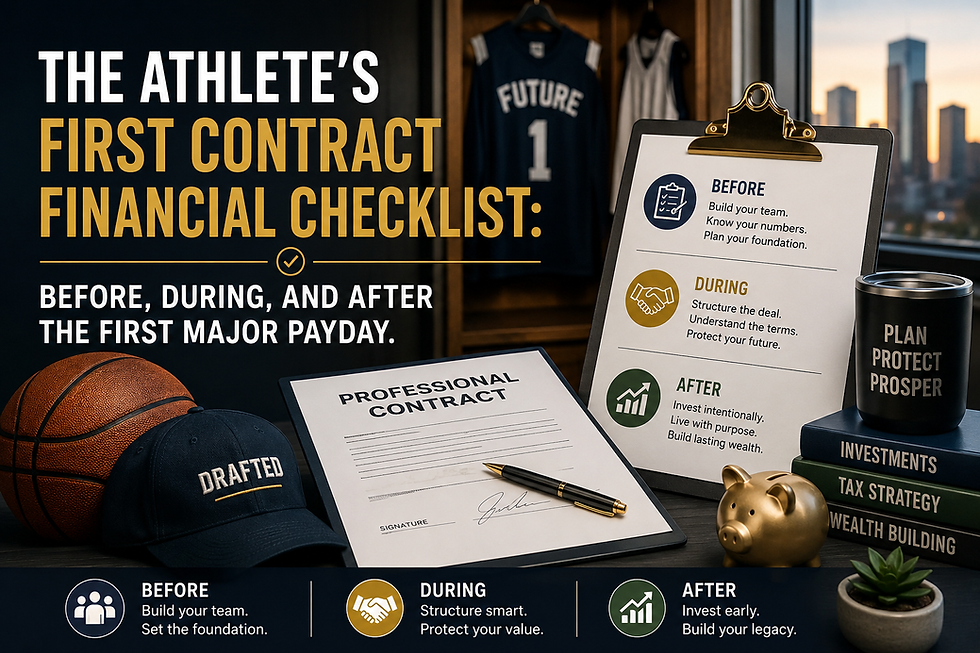
Your first professional contract is one of the greatest moments of your life — and one of the most important financial moments you will ever experience. This first contract financial checklist is built for that moment. It walks you through what to do before the deal is signed, what to get right during negotiation and structuring, and how to put your first major payday to work so that the money you earn in a short, extraordinary career keeps growing for the rest of your life.
I've spent my career helping people turn income into lasting wealth, and athletes face a version of that challenge unlike anyone else: your peak earning years arrive first, often in your early twenties, compressed into a window most professionals never experience. That's not a problem — it's an enormous advantage, if you plan for it. Dollars earned and invested at 22 have decades longer to compound than dollars earned at 45. The athletes who thrive financially aren't the ones who earned the most. They're the ones who had a plan before the first check cleared.
Why Every Athlete Needs a First Contract Financial Checklist
The math of a professional sports career is unique. Your earnings curve is inverted compared to almost every other profession: instead of income building slowly toward your fifties, it arrives fast, peaks early, and then transitions — to a second contract if things go well, to endorsements and business ventures, and eventually to a long life after sport where your investments do the earning for you.
That timeline is exactly why a first contract financial checklist matters. The playing window in most major leagues is measured in years, not decades — while the wealth that contract can create should last fifty years or more.

Here's the encouraging part — and the reason this checklist leads with confidence, not caution: no investor in America has a better structural advantage than a young athlete. You have income most people wait twenty-five years to reach, and you have the one asset money can't buy: time. Get the first twelve months right, and compounding does heavy lifting for the next fifty years.
Before the Payday: First Contract Financial Checklist, Phase One
Everything gets easier when the foundation is in place before the money arrives. If you're projected to be drafted, signed, or called up in the next year, this is your window.
1. Build your team — and understand each seat
Your agent negotiates the contract. Your CPA handles multi-state tax filings. Your attorney reviews what you sign. Your fiduciary financial advisor coordinates all of it around one long-term plan — and, critically, is legally obligated to act in your best interest, compensated by a transparent fee rather than commissions or product sales. Each role is distinct. The most confident athletes I work with are the ones who understand exactly who does what, and who make sure every professional on their team can explain — in plain English — how they get paid.
2. Know your real number before you sign
The figure that gets announced is not the figure that hits your account. Between agent fees, federal income tax, payroll taxes, and the state and city "jock taxes" assessed where you play road games, your take-home on a first contract typically lands well below the headline. That's not bad news — it's simply the number your plan should be built on. Athletes who know their real number spend, save, and invest from a position of clarity instead of surprise.

A simplified, hypothetical illustration. The real breakdown depends on your league, your state of residency, where your games are played, and your individual tax situation — which is exactly why the tax conversation belongs before the signature.
3. Choose your home base deliberately
Where you establish residency is one of the highest-leverage decisions on the entire first contract financial checklist. Tennessee, for example, has no state income tax on wages — one reason Nashville has become a genuine home base for professional athletes and entertainers. You'll still generally owe nonresident taxes in many states where you play road games, but your residency determines how the rest of your income — signing bonuses in some structures, endorsements, investment income — is treated. This decision deserves a real conversation with your CPA and advisor, not a default.
4. Set your baseline lifestyle before the money defines it for you
Decide — now, calmly, before the deposit hits — what your monthly lifestyle number is for year one. Not as a restriction, but as a foundation: when your core lifestyle is intentionally set, every dollar above it becomes fuel for the future instead of a question mark. This is also the moment to establish a simple framework for family requests: a defined annual amount you give joyfully, decided in advance, so generosity is a plan rather than a pressure.
During the Deal: Structuring the First Major Payday
Once negotiations begin, your agent leads — but the financial structure of the deal is where your advisor and CPA earn their seats at the table.
Understand guarantees vs. headline value. Know exactly how much of the contract is fully guaranteed, what's guaranteed for injury only, and what depends on making the roster. Your plan should be built on the guaranteed money; everything above it is acceleration.
Map the signing bonus. A signing bonus is often the largest single check of the deal and may be taxed and timed differently than salary. How it's paid — lump sum vs. installments, and in which tax years — can meaningfully change your outcome.
Know your league's payment mechanics. Some leagues withhold a portion of salary in escrow; some pay only during the season, creating months with no paycheck. Your cash-flow plan should match your league's actual calendar.
Get properly insured. Your future earning power is your biggest asset in year one. Disability coverage — and, where appropriate, loss-of-value coverage — protects the contract years that haven't been signed yet.
Structure endorsement and NIL income correctly. Off-field income often belongs in a business entity with its own bookkeeping, which can open planning opportunities and keeps brand income cleanly separated from playing income.
Open the right accounts before the wire arrives. A dedicated tax reserve account, an operating account for lifestyle, and an investment account — so the first deposit lands into a structure, not a single checking account.

The order matters: reserve is funded first, lifestyle runs on a fixed system, and growth captures everything above the plan — automatically.
After the Check Clears: Putting the First Contract Financial Checklist to Work
This is where most athlete finance content stops — and where the real opportunity begins. Protecting the money is table stakes. Growing it is the point. Your first contract isn't just income; it's seed capital for a portfolio that can outlast your career many times over.
Start compounding immediately — time is your superpower
The single biggest financial edge you have over every other high earner in America is your age. A dollar invested at 22 has roughly two extra decades to compound compared to a dollar invested at 45 — and over long periods, those extra years matter more than almost any other variable you control.

Compounding rewards nothing so much as time — and time is the one asset a rookie has more of than anyone else in the building.
Invest like an owner, not a spectator
At Infinitus, we build athlete portfolios the way we build every portfolio: from individual stocks and bonds, selected and actively managed for your specific situation — never off-the-shelf model portfolios or one-size-fits-all mutual funds. For an athlete, that customization matters more than for almost any other client. Your income is front-loaded, your career timeline is unique, your endorsement income has its own rhythm, and your tax picture spans multiple states. A portfolio built from individual securities can be shaped around all of it — including which of our twelve proprietary strategies fit your stage, from growth-oriented equity strategies in your earning years to income-focused approaches later on.
Coordinate taxes as an ongoing strategy, not an April event
Multi-state filings, signing bonus timing, entity income, and investment decisions all interact. When your advisor and CPA are talking to each other all year — harvesting opportunities, timing recognition, keeping your residency position clean — tax planning becomes a quiet, compounding contributor to your net worth rather than a once-a-year scramble.
Build the second act while you're still in the first
The most successful athletes I've seen treat their playing career as the launchpad, not the whole flight. That means letting your portfolio become a genuine second engine of wealth during your career — so that by the time you decide what's next, whether that's business, broadcasting, or something entirely your own, you're choosing from strength. That is the entire purpose of the first contract financial checklist: not just to get through the first payday safely, but to make it the first chapter of a much bigger story.
Frequently Asked Questions
When should an athlete start working through a first contract financial checklist?
Ideally before the contract is signed — even before the draft or signing period. The pre-payday phase is when you assemble your team, learn your projected take-home, and set the ground rules that make everything afterward simpler. Athletes who start early make decisions from confidence rather than reaction.
How much of a first contract does an athlete actually take home?
After agent fees, federal and payroll taxes, and state and city taxes assessed where games are played, take-home often lands around 50–60% of the gross figure, depending on the league, the states involved, and deal structure. Knowing your real number before you sign is one of the most empowering steps on the checklist.
Should a rookie invest right away or wait until the second contract?
Time is the single greatest advantage a young athlete has as an investor — dollars invested at 22 have decades longer to compound than dollars invested at 30. Building a disciplined investment foundation early, even a modest one, is core to the checklist. The right pace and structure depend on your guarantees and goals.
Do athletes in Tennessee pay state income tax on their contracts?
Tennessee has no state income tax on wages, which makes it one of the most attractive home-base states for professional athletes. You'll still generally owe nonresident "jock taxes" in many states and cities where you play road games — which is why multi-state tax planning belongs on every athlete's checklist.
What's the difference between an agent and a fiduciary financial advisor?
Your agent negotiates the contract and is compensated from it. A fee-only fiduciary advisor is legally obligated to act in your best interest on the financial side — investments, tax coordination, long-term planning — and is paid a transparent fee rather than commissions. The roles complement each other, but they aren't interchangeable.
How does Infinitus Wealth Management work with professional athletes?
Infinitus is an independent, fee-only fiduciary RIA in Nashville that builds custom portfolios from individual stocks and bonds — no commissions, no product sales. Every athlete relationship includes a complimentary financial plan, coordination with your agent and CPA, and an investment strategy built around your career timeline and goals.

Talk to Infinitus About Building Your Custom Portfolio
At Infinitus Wealth Management, we build every client a custom portfolio from individual stocks and individual bonds—never mutual funds, rarely an ETF—actively managed and hedged with options where it strengthens the portfolio. We are an independent, fee-only fiduciary: no commissions, no proprietary products, no conflicts pulling against you. Our twelve proprietary strategies give us the range to tailor a portfolio to your tax situation, income needs, and goals, whether you are early in building serious wealth or managing well into eight figures.
If you would like a clear-eyed look at how your current portfolio is actually structured—what it is costing you in fees and tax drag, whether it is being managed at the level of individual holdings, and whether your advisor’s incentives are genuinely aligned with yours—we welcome the conversation. Our complimentary portfolio analysis gives you an objective, holding-level assessment and a direct view of what a custom Infinitus portfolio would look like for you.

The High-Net-Worth Wealth Management Checklist for Families With $5M to $25M
Managing Portfolio Risk When Your Income and Stock Are Tied to One Company
Generating Income with Stock Options: Strategies and Insights
Navigating Tax Implications for High Net Worth Individuals: Strategies to Reduce Your Taxes
Important Disclosures
Infinitus Wealth Management is a registered investment advisory firm. This article is provided for educational and informational purposes only and does not constitute investment, tax, legal, or accounting advice. It is not an offer or solicitation to buy or sell any security or to enter into any advisory relationship. Any references to specific strategies, withdrawal rates, tax provisions, or historical figures are general in nature and may not be appropriate for any individual investor.
Past performance is not indicative of future results. All investing involves risk, including the possible loss of principal. Tax laws are complex, change frequently, and have unique application to individual circumstances; please consult a qualified tax professional regarding your specific situation. Social Security rules, Medicare rules, and retirement account regulations are subject to legislative and regulatory change.
The information in this article was believed to be accurate at the time of writing but is not guaranteed. Readers should consult with their own qualified advisors before making any financial decisions specific to their situation.