
The Veteran Business Owner's Guide to Succession Planning Inside the Family


Handing your company to the next generation is one of the most meaningful things a founder can do. Done deliberately — over years, not months — it strengthens the business, the family, and your own next chapter all at once.
For a veteran founder, family succession planning carries a meaning that goes beyond the balance sheet. The company you built after your service is part of your story — and the idea of a son or daughter carrying it forward is one of the most powerful legacies available to any business owner. It is also entirely achievable when you treat it the way you would treat any mission: with a clear objective, a realistic timeline, and a team assembled around you.
I write this as someone who has lived the veteran-to-founder arc. I was in high school on September 11, 2001, enlisted to serve on the front lines, and served in the infantry with the 101st Airborne, where I earned a Purple Heart. After the Army, I discovered investing through the Wall Street Warfighters Foundation, spent years working as a financial and wealth advisor, earned my MBA at Wharton, and founded Infinitus Wealth Management.
Today much of my work is with veteran business owners planning the biggest transitions of their lives. This guide walks through succession planning inside the family: what actually transfers, how the SDVOSB question shapes your timeline, how the handoff works in practice, and how to keep the plan fair to every child — including the ones who never set foot in the business.
Start With What Transfers — and What Stays With You
The first step in family succession planning is an honest inventory of what your successor will actually receive. Most of the company's value passes down beautifully: the operations, the team and culture, the customer relationships, the past performance record, the systems you built. Those are durable assets, and a well-prepared successor inherits all of them.
One thing does not pass down, and for a government contractor it is worth naming early: your SDVOSB certification. Set-aside eligibility rests on majority ownership and control by a service-disabled veteran — it belongs to your service, not to the company's stock certificates. That creates two clean planning paths, and both lead somewhere good.

If your successor is also a service-disabled veteran — a child who served and has a service-connected disability rating — the company can pursue recertification under their ownership and keep competing for set-aside work. This is the fullest form of continuity, and families in this position should coordinate the ownership and control transition carefully with counsel so eligibility is preserved at every stage.
If your successor is not a service-disabled veteran, you have something just as valuable: time. A succession you begin planning five or more years out gives you a full runway to grow full-and-open, subcontracted, and commercial revenue so the business your child inherits stands on channels they can compete in under their own name. I covered how that revenue mix drives value in The SDVOSB Exit — the same logic applies whether the next owner is a stranger or your daughter.
The Handoff Is a Relay, Not a Single Day
The most durable family successions treat leadership transfer as a multi-year relay with a long exchange zone — a period where both generations are on the track together, at full speed, before the baton changes hands. Five to seven years is a realistic horizon, and every phase of it does real work.

A few principles make the relay work. Let your successor earn real credibility — running a division with genuine P&L responsibility, winning work under their own leadership, making hiring decisions that stick. Introduce them personally to your key customers, contracting officers, and banking relationships while you are still in the room to transfer trust. And put the milestones in writing: employees, customers, and family members all perform better when the plan is visible rather than implied.
Veterans have an advantage here that I see constantly: you already know how to develop leaders. The military hands responsibility to young people earlier than almost any institution on earth, backed by training, standards, and after-action honesty. Bring that same doctrine to developing your successor and the handoff will feel familiar.
Transferring Ownership: Stages, Structure, and the 51% Moment
Leadership and ownership are separate tracks in succession planning, and they usually should move at different speeds. It is common — and often wise — for a successor to run the company day-to-day for years before majority ownership transfers.

The toolkit for moving equity inside a family is rich: annual gifting programs, installment sales, trust structures, recapitalizations that separate voting from economic interests, and buy-sell agreements that govern what happens in every scenario. Each tool has meaningful tax and legal dimensions, and the right combination is personal — which is why your estate attorney and CPA should design the schedule together, well before the first share moves.
For SDVOSB families, one waypoint on the chart deserves special attention: the 51% crossover. While the company competes for set-aside work, eligibility depends on the service-disabled veteran holding unconditional majority ownership and genuine control. That makes the crossover a strategic decision, not just a paperwork date. If your successor also qualifies, counsel will sequence the transfer so certification continuity is protected. If they do not, the crossover is the natural milestone around which you time the pipeline shift toward channels the next generation competes in directly. Either way, the moment is knowable years in advance — which means it is plannable.
Leadership can transfer on merit and readiness. Ownership should transfer on structure and timing. Families that separate the two tracks give each one room to be done right.
Fair Doesn't Always Mean Equal: Providing for Every Child
The most delicate part of succession planning inside the family usually is not the business at all — it is the children who are not in it. Handing the company to the child who runs it, while treating siblings fairly, is one of the oldest challenges in family enterprise. It is also very solvable.

The core idea is equalization: the successor receives the business — an asset that carries both opportunity and risk, and that they will spend a career growing — while other children are provided for through different assets sized to balance the ledger. Investment portfolios, real estate, and insurance-funded arrangements are the common building blocks, and your estate attorney and CPA will fit them to your numbers.
Structure solves half the problem. Communication solves the rest. The successions that hold families together share one habit: the parents explain the plan themselves, in person, while everyone is in the room — what each child receives, why the design is fair, and what values sit underneath it. A family meeting like that is uncomfortable for exactly one afternoon. Silence is uncomfortable for a generation. Choose the afternoon.
Succession Planning for Your Own Next Chapter
There is one more person the plan has to provide for: you. The quiet flaw in many family successions is that the parents' retirement remains financed by the business they just handed off — through ongoing salary, rent, or an installment note that makes their security dependent on the next generation's results. That arrangement puts weight on the successor and anxiety on the founder, and it is avoidable with the same lead time everything else in this guide requires.
In the years before the handoff, deliberately move wealth out of the company and into assets you own outright — so that by the time the baton passes, your household runs on income that does not depend on the company's next contract. This is where my work begins. Infinitus builds custom portfolios exclusively from individual stocks and bonds — never mutual funds — selected through our own research process across our proprietary strategies, as a fee-only fiduciary. For founders stepping back, we design around exactly this objective: durable income and long-term growth from securities you can see, understand, and own directly, including approaches like our Dividend Income & Growth Strategy and Capital Preservation & Risk Management discipline.
When your independence is funded before the handoff, everything else gets easier. You can transfer ownership on the schedule that serves the family rather than your cash flow. Your successor inherits a company unburdened by supporting two generations. And you step into the next chapter — advising, mentoring, building something new — from strength. That is succession planning done completely: the company continues, every child is provided for, and the founder is free.
Family Succession Questions, Answered
Can my child inherit my SDVOSB status along with the business?
The certification itself cannot be inherited — it rests on majority ownership and control by a service-disabled veteran. If your successor independently qualifies, the company can pursue recertification under their ownership and continue competing for set-aside work. If not, the business still transfers with its full capabilities and relationships, and the years before the handoff are your window to build the full-and-open and commercial channels the next generation will compete in directly.
How long should a family succession take?
Five to seven years is a strong runway. It gives your successor time to earn credibility, lets ownership move in deliberate stages, and gives you room to build financial independence outside the business before stepping back.
How do I keep things fair for children who are not in the business?
Fair does not have to mean identical. A common design directs the business to the child who runs it and equalizes the others through different assets — portfolios, real estate, insurance proceeds — sized with your estate attorney and CPA. Pair the structure with a family meeting where you explain the plan yourself.
When should I start succession planning?
While the question is still theoretical. Starting five or more years ahead gives every piece — successor development, staged ownership transfer, estate coordination, and your own financial independence — the time it needs to be done well.

About the Author
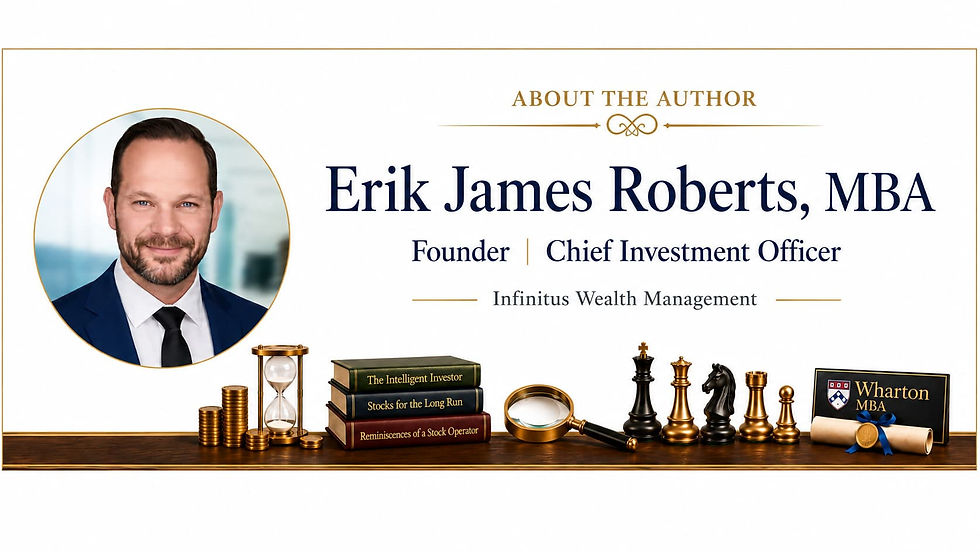
Erik Roberts is the Founder and Chief Investment Officer of Infinitus Wealth Management, a fee-only independent fiduciary firm in Nashville, Tennessee that builds custom portfolios exclusively from individual stocks and bonds. Erik was in high school on September 11, 2001, enlisted to serve on the front lines, and left for the Army immediately after graduation, serving in the infantry with the 101st Airborne Division, where he earned a Purple Heart. He discovered investing through the Wall Street Warfighters Foundation, then spent years working as a financial and wealth advisor, and holds an MBA from the Wharton School of the University of Pennsylvania.Erik works closely with veteran business owners on the financial dimensions of building, growing, and transitioning their companies.
Related Topics
Important Disclosures. This article is provided for general informational and educational purposes only and does not constitute investment, legal, tax, estate-planning, or accounting advice, nor an offer to buy or sell any security. Nothing herein should be construed as a recommendation of any specific security, strategy, structure, insurance product, or course of action, or as a solicitation of advisory services. Discussions of SDVOSB certification, SBA regulations, ownership and control requirements, gifting, trusts, buy-sell agreements, and estate equalization are general in nature, are not legal or tax advice, and may not reflect the most current law or regulations; readers should consult a qualified estate-planning attorney, government contracts counsel, and a CPA regarding their specific circumstances before making any decisions.
All charts and graphics are hypothetical and for illustrative purposes only; they do not represent any actual family, company, transfer schedule, or investment result. Investing involves risk, including the possible loss of principal. Diversification does not ensure a profit or protect against loss. Past performance is not indicative of future results.
Infinitus Wealth Management is a registered investment adviser. Registration does not imply a certain level of skill or training. Advisory services are offered only to clients or prospective clients where Infinitus Wealth Management and its representatives are properly licensed or exempt from licensure. For additional information, please refer to our Form ADV, available upon request.


