
How Do You Build a Roth Conversion Ladder in Your 30s?


Erik James Roberts, Founder & CIO, Infinitus Wealth Management. Purple Heart recipient, Wharton MBA.
Updated September 17, 2026
A Roth conversion ladder in your 30s is built by moving a planned slice of pre-tax retirement money into a Roth IRA each year, sized to fill your current tax bracket, so that every rung seasons for five years and then has decades to grow tax-free. You pay ordinary income tax on each conversion in the year you make it. In exchange, that money and its future growth can come out tax-free in retirement, and the converted principal becomes accessible without penalty after five years.
There is a detail that reshapes the whole strategy, and most investors have it backwards. Rising income does not close the door on Roth conversions. It closes the door on direct Roth contributions. Conversions are open at every income level. What your career changes is the price of each rung, and in your 30s that price is often the lowest it will be for the next 25 years.
What Is a Roth Conversion Ladder?
A Roth conversion ladder is a multi-year schedule of partial Roth conversions. Instead of converting a large pre-tax balance at once and stacking all of that income into one tax year, you convert a measured amount each year. Each conversion is a rung. Each rung has its own five-year clock. Once a rung's clock finishes, that converted principal can be withdrawn at any age with no tax and no penalty.
The strategy became popular with early retirees who needed a bridge to their money before age 59½. For investors in their 30s with rising careers, the ladder does something more valuable: it moves money from the taxable-later column to the tax-free column while the conversion is inexpensive, and it gives that money the longest possible runway.
Three traits make the Roth side of a portfolio worth building early:
Tax-free growth. Qualified withdrawals of earnings are free of federal income tax.
No required minimum distributions for the original owner, so the money compounds on your schedule.
Tax diversification. Holding pre-tax, Roth, and taxable accounts gives you control over your taxable income in every future year.
Does Your Income Limit Roth Conversions?
No. There is no income limit on Roth conversions, and there is no cap on the amount you can convert in a year. Congress removed the conversion income limit in 2010.
The income limits people hear about apply to direct Roth IRA contributions. For 2026, the ability to contribute directly phases out between $153,000 and $168,000 of modified adjusted gross income for single filers, and between $242,000 and $252,000 for married couples filing jointly. The 2026 contribution limit is $7,500.
So a professional whose income passes those thresholds still has two open paths into a Roth:
The backdoor Roth, which is a nondeductible traditional IRA contribution followed by a conversion. It is a one-rung ladder, repeated annually.
The Roth conversion ladder, which moves existing pre-tax balances, such as an old 401(k) rolled into an IRA, across in planned pieces.

Why Are Your 30s the Prime Decade for a Roth Conversion Ladder?
Your 30s combine two advantages that rarely appear together again: a comparatively low tax bracket and the longest compounding horizon you will ever have. Every dollar converted is taxed at today's marginal rate, so the best conversion years are the ones where that rate is lowest relative to your future.
Consider a hypothetical married couple earning $180,000. After the $32,200 standard deduction, their 2026 taxable income is $147,800. The 22% bracket for joint filers runs to $211,400, which leaves $63,600 of room. A $60,000 conversion fits inside it and adds roughly $13,200 of federal tax.
Now move the same couple forward a decade, with income that places them in the 32% bracket. The identical $60,000 conversion costs about $19,200. Same rung, $6,000 more expensive. Across a five-rung ladder, bracket timing alone is a $30,000 difference in this illustration. This is a simplified hypothetical that ignores credits, phase-outs, and other items a CPA would model for your actual return.

Certain years are especially well suited to a larger rung:
Graduate school or a career pivot. A year or two of reduced income is a premium conversion window.
Launching a business. Early-stage owner income is often modest, and startup losses can offset conversion income.
Parental leave or a sabbatical.
Between contracts. Athletes and entertainers can see sharp swings in income from one year to the next, and a low year is a conversion window.
After a job change, when an old 401(k) can be rolled into an IRA and converted in stages. It is also a natural moment to review stock options, restricted stock, and deferred compensation alongside the conversion schedule.
If you live in Tennessee, there is an added advantage: the state does not tax individual income, so a conversion here carries federal tax only.
How Do You Build a Roth Conversion Ladder, Step by Step?
1. Inventory your pre-tax accounts. List every traditional IRA, rollover IRA, SEP, SIMPLE, and old employer plan. These are the raw material for the ladder.
2. Measure your bracket headroom each fall. Project your taxable income for the year, then find the distance to the top of your current bracket. That distance is your natural conversion size. Conversions must be completed by December 31 to count for that tax year. Unlike IRA contributions, there is no April grace period.
3. Pay the tax from outside cash. This is what makes the math work. If tax is withheld from the conversion itself, the withheld amount counts as a distribution, and if you are under 59½ it is generally subject to a 10% penalty on top of income tax. Paying from savings keeps the full amount working inside the Roth. Coordinate withholding or an estimated payment so the added income is covered.
4. Mind the pro-rata rule. If you hold both pre-tax and after-tax dollars across your IRAs, the IRS treats every conversion as a proportional blend of the two, measured on December 31 of the conversion year. This matters most for backdoor Roth contributions. One common solution is rolling pre-tax IRA money into a current employer 401(k), if the plan accepts it, since 401(k) balances sit outside the calculation. Conversions are reported on Form 8606.
5. Treat each rung as final. Since 2018, a conversion cannot be reversed. That is a reason to size rungs from a real income projection late in the year, which is exactly when the numbers are clearest.
6. Repeat annually and adjust. A ladder is a schedule, and the schedule flexes. A strong income year may call for a small rung. A lean year may call for a large one.
How Does the Five-Year Rule Work on Each Rung?
Each conversion has its own five-year clock, and the clock starts on January 1 of the year you convert, regardless of the actual date. A conversion made in December 2026 is treated as starting January 1, 2026, and its principal becomes available penalty-free on January 1, 2031.
Roth IRA withdrawals come out in a fixed order: regular contributions first, then conversions from oldest to newest, then earnings. Contributions are always accessible. Seasoned conversions are accessible. Earnings are the last layer, and those generally need to stay until 59½ to come out tax-free.
For a 30-something, this creates valuable optionality. The goal is to leave the Roth untouched for decades. But after five years, each rung also functions as a reserve of accessible capital, which can make it easier to commit to the strategy with confidence.

What Should You Own Inside the Roth?
This is where a Roth conversion ladder shifts from a tax exercise to an investment decision, and it is the part I care about most as a CIO. A tax-free account with a 25 to 30 year horizon is the most valuable real estate in your portfolio. It deserves your highest-conviction long-term growth holdings.
At Infinitus, we build each client's portfolio from our 12 proprietary strategies, and account location is part of the construction. Long-horizon growth strategies are natural candidates for the Roth, where decades of appreciation will never be taxed. Holdings that are already tax-advantaged, such as municipal bonds, belong elsewhere. The same securities can produce a meaningfully different after-tax outcome depending on which account holds them.
Two further investment points:
Conversions can be made in kind. You can move shares rather than cash. When quality companies you intend to own for decades are trading at lower prices, the same number of shares converts at a lower taxable value, and the recovery happens inside the Roth.
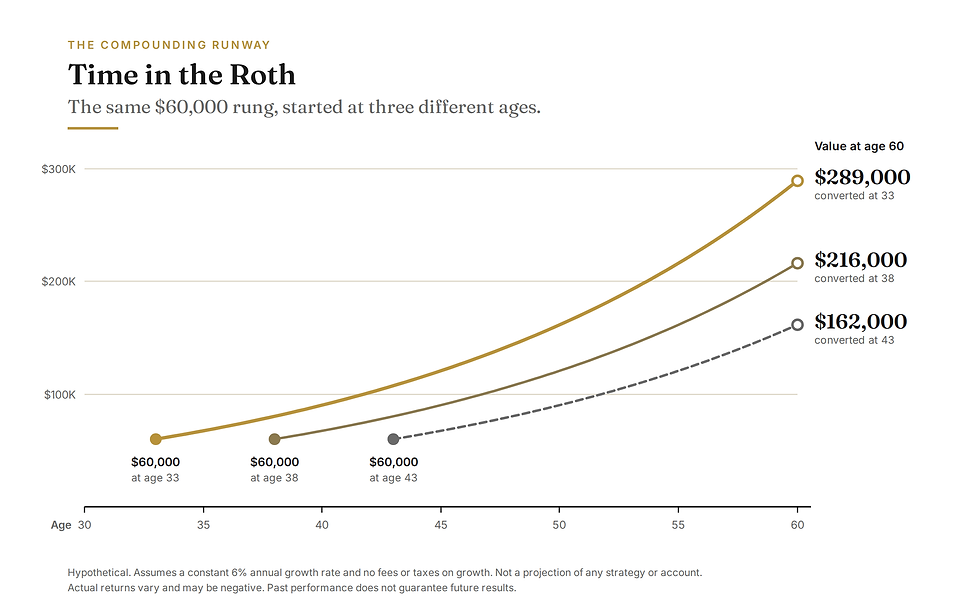
Time is the multiplier. In a hypothetical illustration, $60,000 converted at age 33 and compounding at an assumed 6% annually reaches about $289,000 by age 60. The same conversion at 38 reaches about $216,000, and at 43 about $162,000. These figures are hypothetical, assume a constant return that real markets do not deliver, do not reflect fees, and are not a projection of any Infinitus strategy. Past performance does not guarantee future results.
What Else Should You Coordinate?
A conversion raises your adjusted gross income for that year, so a few items are worth checking alongside it: eligibility for credits tied to income, health insurance premium credits if you buy marketplace coverage, and income-driven student loan payments. None of these are obstacles. They are inputs that help set the right rung size. In taxable accounts, tax-loss harvesting and capital gains management can be coordinated in the same year-end review.
This is CPA territory, and the best results come when your tax professional and your portfolio manager work from the same plan. If you do not already have a CPA you trust, Infinitus can connect you with one, along with estate planning attorneys and other professionals when the situation calls for them.
Frequently Asked Questions
Is there an income limit for a Roth conversion ladder?
No. Roth conversions have no income limit and no dollar cap. Income limits apply only to direct Roth IRA contributions, which for 2026 phase out between $153,000 and $168,000 for single filers and between $242,000 and $252,000 for joint filers.
How much should I convert each year?
A common approach is to convert enough to fill your current tax bracket without crossing into the next one. Project your taxable income in the fourth quarter, measure the distance to the top of your bracket, and size the rung to that headroom, confirming the figure with your CPA.
What is the difference between a Roth conversion ladder and a backdoor Roth?
A backdoor Roth converts a new nondeductible IRA contribution each year, up to the $7,500 limit for 2026. A Roth conversion ladder converts existing pre-tax balances in planned annual amounts of any size. Many high earners use both.
Do I pay a penalty on a Roth conversion in my 30s?
The conversion itself carries no penalty, only ordinary income tax on the pre-tax amount converted. A 10% penalty can apply if you withdraw converted principal within five years while under 59½, or if you have tax withheld from the conversion amount.
Can I undo a Roth conversion?
No. Since 2018, Roth conversions are permanent. Sizing each rung late in the year, once your income is clear, keeps every conversion deliberate.
Is it smart to convert when the market is down?
Converting shares in kind at lower prices means a lower taxable value for the same holdings, with any recovery occurring inside the Roth. Whether that fits depends on your tax picture, your cash available to pay the tax, and the quality of what you own.
Put the Roth to Work
A Roth conversion ladder is only as good as the portfolio inside it. If you would like a custom portfolio built with every account in its most productive role, start with an introductory conversation. For Infinitus clients, conversion strategy is coordinated as part of the complimentary financial plan included in the advisory fee.

Disclosures. Infinitus Wealth Management is a registered investment adviser. Registration does not imply a certain level of skill or training. This article is for informational and educational purposes only and does not constitute individualized investment, tax, or legal advice, or an offer to buy or sell any security. Infinitus Wealth Management does not provide tax or legal advice. Tax laws are complex and subject to change, and the figures cited reflect 2026 federal rules as of the date shown above. Consult a qualified CPA or tax attorney regarding your specific circumstances before implementing any strategy discussed here. All examples are hypothetical, are provided for illustration only, do not represent any actual client or account, and do not reflect the deduction of advisory fees or other expenses. Hypothetical growth rates are assumptions, not predictions. All investing involves risk, including the possible loss of principal. Past performance does not guarantee future results.


